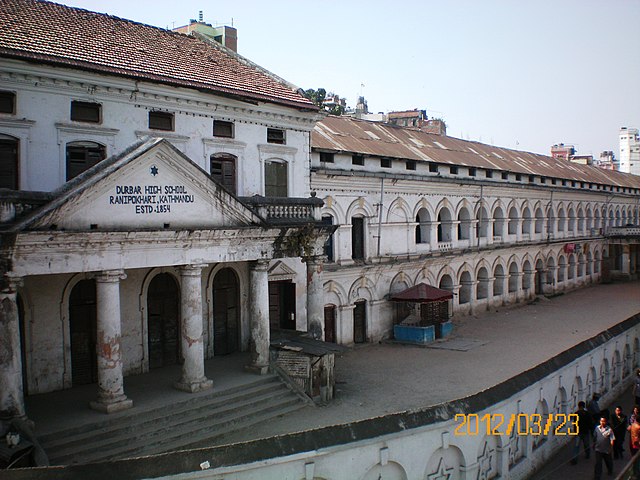
First modern school established in Nepal: Durbar High School.
Kathmandu, Nepal
 scale(5.56106)'%3e%3ccircle r='1'/%3e%3cg id='d'%3e%3cg id='c'%3e%3cpath id='b' d='M.195-.98 0-1.39l-.195.408' transform='rotate(11.25)'/%3e%3cuse xlink:href='%23b' transform='rotate(22.5)'/%3e%3cuse xlink:href='%23b' transform='rotate(45)'/%3e%3c/g%3e%3cuse xlink:href='%23c' transform='rotate(67.5)'/%3e%3c/g%3e%3cuse xlink:href='%23d' transform='scale(-1 1)'/%3e%3c/g%3e%3cg transform='translate(0 58.787) scale(8.1434)'%3e%3ccircle r='1'/%3e%3cg id='g'%3e%3cg id='f'%3e%3cpath id='e' d='M.259.966 0 1.576l-.259-.61'/%3e%3cuse xlink:href='%23e' transform='rotate(180)'/%3e%3c/g%3e%3cuse xlink:href='%23f' transform='rotate(90)'/%3e%3c/g%3e%3cuse xlink:href='%23g' transform='rotate(30)'/%3e%3cuse xlink:href='%23g' transform='rotate(60)'/%3e%3c/g%3e%3c/g%3e%3c/svg%3e)
Education
8 min read
Updated By: History Editorial Network (HEN)
Published:
Updated:
The establishment of Durbar High School marked a pivotal moment in the educational history of Nepal. Prior to this, formal education systems were almost non-existent in the country, mainly restricted to religious and monastic teachings. The modern school, established under the Rana regime, was a significant step toward formalizing education in Nepal.
The school was founded in the heart of Kathmandu, signaling a commitment to providing structured education. It was modeled on British educational institutions, reflecting the influence of Western education. Initially, Durbar High School catered mostly to the children of the ruling elite. It aimed to create an educated class that could assist in administrative functions.
The introduction of subjects like mathematics, science, and English opened new avenues for learning. A structured curriculum and the introduction of examinations were major changes. Pioneering educators and administrators, many of whom had been educated abroad, played crucial roles in establishing the school's reputation.
Durbar High School's establishment had long-term impacts. By setting a precedent for formal education, it encouraged the establishment of other schools and educational institutions in Nepal. It contributed to the rise of a new generation of educated individuals who became instrumental in various sectors including governance, business, and academia.
Statistics from subsequent decades show a gradual but steady increase in the literacy rate, attributable in part to these foundational efforts. Previously, the literacy rate was negligible, but the school's influence began to change this dynamic over time.
The establishment of Durbar High School was a crucial turning point in shaping the educational landscape of Nepal. It laid the groundwork for future educational policies and reforms, setting the country on a path toward modernization.
Established in 1854 AD (originally in 1910 BS), Durbar High School is the first modern educational institution in Nepal. While originally reserved for the ruling elite, it was opened to the general public in 1902 by Dev Shumsher Jang Bahadur Rana.
Establishment and History:
• Founder: It was founded by Jung Bahadur Rana following his return from a visit to Europe, where he was inspired by the Western education system.
• Original Purpose: Initially, it was an English elementary school created exclusively for the children of the Rana family and other aristocratic elites.
• Public Access: Access was granted to children of high-ranking government officials in 1876, and it finally became a public institution in 1902.
• Affiliation: Because Nepal lacked a local university, the school was originally affiliated with Calcutta University (until 1917) and later Patna University for entrance examinations.
The school is situated in the heart of Kathmandu, specifically on the west side of Rani Pokhari. It began in a small room at Thapathali Durbar and shifted several times (Charburja Durbar, Seto Durbar, and Narayanhiti Durbar) before settling in its current permanent location in 1891. After being destroyed in the 2015 earthquake, the iconic building was reconstructed with Chinese aid and reopened in 2020. It currently (as of January 2026) houses two schools: Bhanu Secondary School and Sanskrit Secondary School.
Note: The exact date in 1902 when Durbar High School was opened to the public is not specified in available historical records. Sources only confirm the year of the event. The school was made accessible to the general public in 1902 AD (or some sources state 1900 AD) by the order of then Prime Minister Dev Shumsher Jang Bahadur Rana or Chandra Shumsher Jang Bahadur Rana, depending on the source.
#MoofLife #NepalEducation #HistoricalMilestone #FormalEducation
#DurbarHighSchool
Primary Reference
Durbar High School - Wikipedia

Explore the Life Moments of
 AI Twin