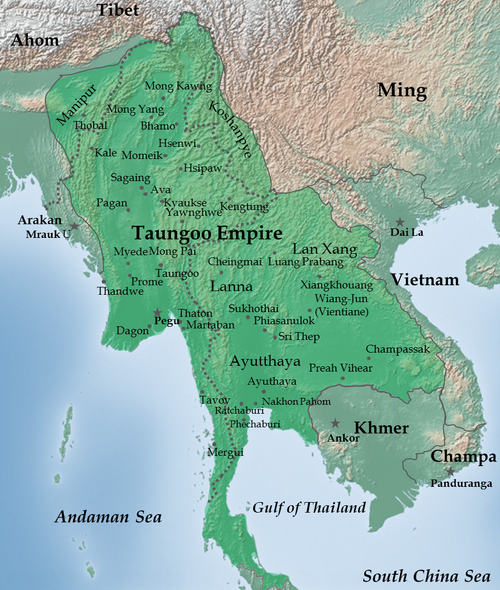
Taungoo's Historical Significance and Portuguese Involvement
Myanmar
Dynasty
Arakanese
3 min read
Updated By: History Editorial Network (HEN)
Published:
Updated:
The Taungoo dynasty emerged as a powerful force in the region after conquering the kingdom that had been weakened by the inexperience of its last ruler. This takeover occurred in 1539, marking the beginning of Taungoo's significant influence in Southeast Asia. The dynasty briefly revived the kingdom's fortunes between 1550 and 1552, managing to exert control primarily over Pegu. However, this resurgence was short-lived as Taungoo forces ultimately crushed the remnants of the kingdom in 1552, solidifying their dominance in the area. The Taungoo dynasty's rise was characterized by military strength and strategic governance, which allowed them to expand their territory and influence significantly during this period.
The historical significance of Taungoo is further highlighted by the events surrounding the sack of Pegu. In a notable incident, Arakanese forces, supported by Portuguese mercenaries and discontented Taungoo factions, attacked Pegu. This assault led to widespread chaos and instability in the region, demonstrating the complex interplay of local and foreign powers during this time. The involvement of Portuguese mercenaries indicates the broader geopolitical dynamics at play, as European powers sought to extend their influence in Southeast Asia. The chaos that ensued from the sack of Pegu had lasting implications for the region, affecting trade routes and local governance, and contributing to the eventual decline of the Taungoo dynasty's power.
#mooflife
#MomentOfLife
#TaungooDynasty
#Pegu
#PortugueseMercenaries
#SoutheastAsiaHistory
#ArakaneseForces

Explore the Life Moments of
 AI Twin