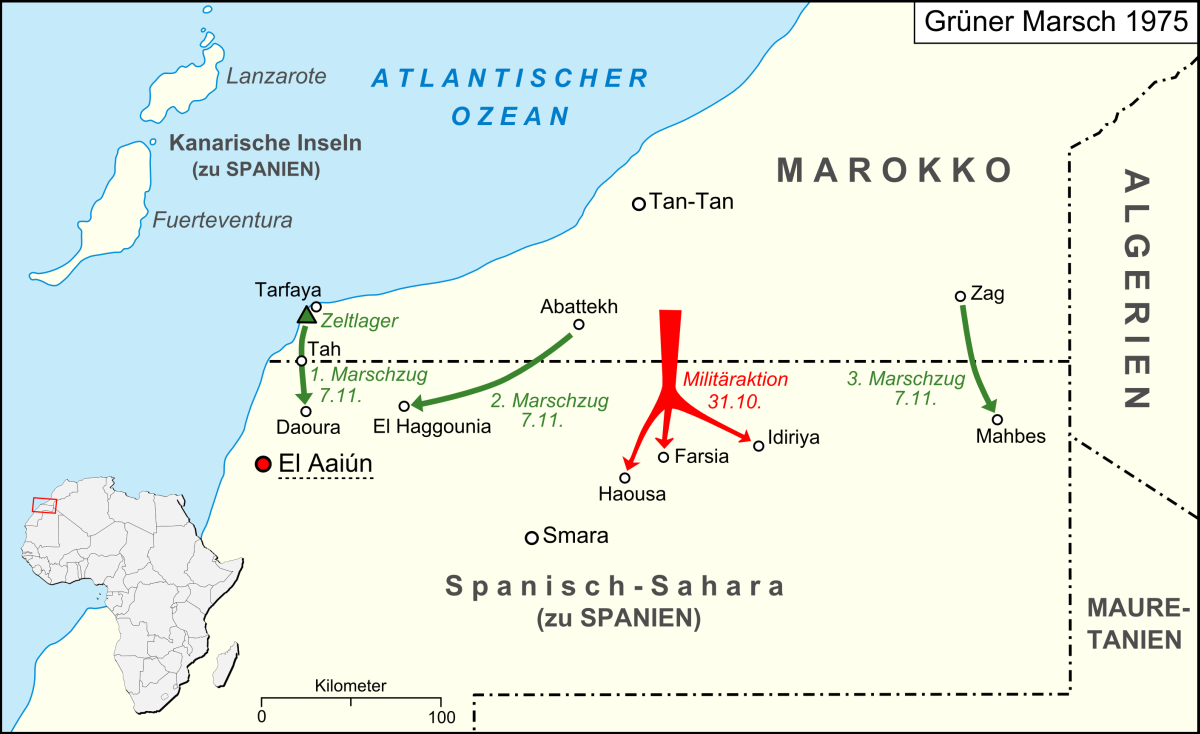
King Hassan II's call for Western Sahara reintegration led to Green March.
Political
Territorial Claim
4 min read
Updated By: History Editorial Network (HEN)
Published:
In an effort to reclaim Western Sahara, King Hassan II led the Green March, a peaceful mass demonstration involving 350,000 Moroccans. This action aimed to call for the reintegration of the region, which was under Spanish control.
The background to the Green March dated back to colonial times when Spain ruled over Western Sahara. King Hassan II saw an opportunity to assert Morocco's territorial claim as Spain was withdrawing from the region. By organizing the Green March, he sought to mobilize public support and pressure Spain to hand over Western Sahara to Morocco.
The impact of the Green March was significant. It led to Spain agreeing to transfer the administration of Western Sahara to Morocco and Mauritania through the Madrid Accords. However, unresolved territorial disputes eventually resulted in conflict with the Polisario Front, a Sahrawi nationalist movement seeking independence for Western Sahara.
The Green March demonstrated the power of mass mobilization and diplomacy in achieving political goals. It solidified Morocco's claim to Western Sahara in the international arena, despite ongoing challenges from the indigenous Sahrawi population represented by the Polisario Front.
In conclusion, the Green March marked a crucial moment in Morocco's history, shaping its territorial boundaries and foreign relations. The event underscored the complexity of decolonization processes and the enduring impact of colonial legacies on contemporary geopolitics.
#Morocco #WesternSahara #GreenMarch #TerritorialClaim #Decolonization
Primary Reference
Documents - CURIA
Explore the Life Moments of
 AI Twin