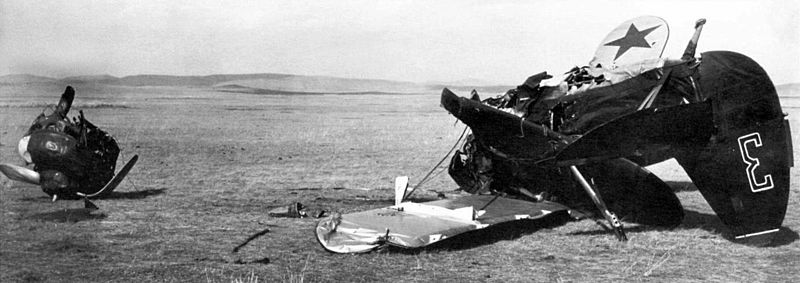
Truce after decisive Japanese defeat at Battle of Khalkhyn Gol
Mongolia

Military
5 min read
Updated By: History Editorial Network (HEN)
Published:
The Battle of Khalkhyn Gol was a pivotal military confrontation between the Soviet Union and Japan. It took place along the disputed border between Mongolia, a Soviet ally, and the Japanese-occupied territory of Manchukuo. The conflict was the result of a long-standing territorial dispute and rising tensions, which ultimately escalated into full-scale hostilities.
The Japanese forces, under the command of General Komatsubara, sought to assert control over the contested area. The Soviet Union, led by General Georgy Zhukov, responded with significant mechanized and air force capabilities. The combat saw extensive use of tanks, artillery, and aircraft, marking it as one of the early large-scale mechanized conflicts of the era.
With over 60,000 troops engaged on each side, the battle witnessed intense fighting. Soviet and Mongolian forces implemented superior strategic planning and supply lines, coupled with effective use of their armored divisions. By the end of the confrontation, Japanese forces suffered significant casualties, estimated to be around 17,000 killed and wounded, whereas Soviet and Mongolian casualties were estimated at approximately 18,000.
The decisive Soviet victory at Khalkhyn Gol had far-reaching consequences. The Japanese defeat led to a reevaluation of military strategies and played a role in redirecting Japan’s expansionist focus southward, away from the Soviet Union. This engagement functioned as a precursor to the larger hostilities of World War II, influencing the strategic calculations of both nations.
Following the battle, a truce was negotiated between Japan and the Soviet Union. This agreement stabilized the region and allowed both sides to redirect their military efforts towards other fronts. The truce, however, was more of an uneasy ceasefire rather than a lasting peace.
The Battle of Khalkhyn Gol demonstrated the effectiveness of combined arms operations and highlighted the importance of logistics and strategic planning in modern warfare. The conflict served as an early test for Soviet military doctrine, which would later be applied on the Eastern Front during World War II.
#KhalkhynGol #SovietVictory #Mongolia #Japan #MilitaryHistory #MoofLife
Primary Reference
Battles of Khalkhin Gol - Wikipedia

Explore the Life Moments of
 AI Twin