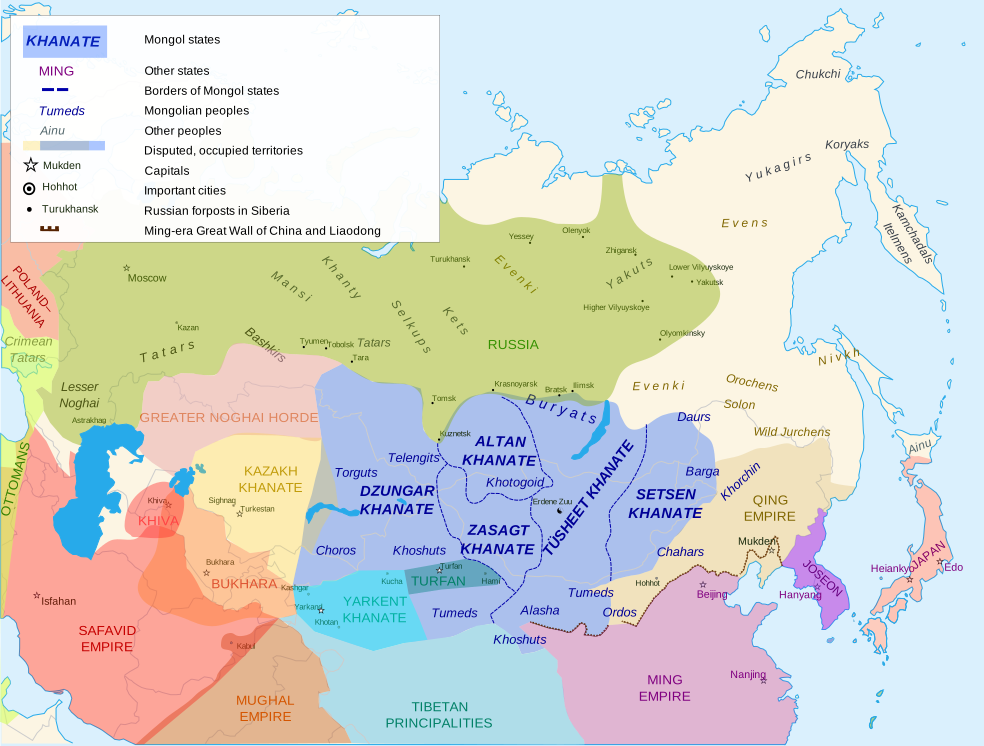
Establishment of the Altan Khanate by the Khalkha Mongols
Mongolia

10 min read
Updated By: History Editorial Network (HEN)
Published:
In 1576, the Altan Khanate was established by the Khalkha Mongols, under the leadership of Altan Khan. This significant event marked the emergence of a powerful Mongol state that played a crucial role in the religious, political, and cultural dynamics of Central Asia, particularly in the relationship between Mongolia and Tibet.
Background: The Fragmentation of the Mongol Empire
After the fall of the Yuan Dynasty in China in 1368, the vast Mongol Empire, which had been unified under Genghis Khan and his descendants, began to fragment into smaller khanates and tribes. These groups often vied for power, territory, and influence across the steppes of Central Asia. The Khalkha Mongols, who were one of the major Mongol tribes, occupied a large region in what is now modern-day Mongolia and parts of Inner Mongolia.
During the 16th century, the Mongols were no longer the dominant force they had once been under the Great Khans. The various Mongol tribes were divided and frequently engaged in conflicts with each other as well as with neighboring powers such as the Chinese Ming Dynasty, the Oirat Mongols, and the Manchus.
The Rise of Altan Khan
Altan Khan, born as Batu Möngke in 1507, was a direct descendant of Kublai Khan, the founder of the Yuan Dynasty. He was a member of the Tümed Mongols, a subgroup of the Khalkha Mongols. As a skilled leader and military strategist, Altan Khan gradually expanded his influence, uniting various Mongol tribes under his leadership. By 1576, he had consolidated enough power to establish what became known as the Altan Khanate.
Altan Khan took the title "Khan," reviving the traditional Mongol title used by Genghis Khan and his successors. The establishment of the Altan Khanate marked a period of political consolidation and revitalization of Mongol power in the region. Under Altan Khan's leadership, the Mongols experienced a resurgence, with the Altan Khanate becoming a significant force in Central Asia.
Establishment of the Altan Khanate
The creation of the Altan Khanate in 1576 was more than just a political move; it was also a cultural and religious turning point for the Mongols. Altan Khan sought to unite the Mongol tribes not only through military strength but also through the adoption of Tibetan Buddhism, which he saw as a unifying force that could bring stability and legitimacy to his rule.
1. Expansion and Consolidation:
Altan Khan successfully expanded the territory of the Altan Khanate by securing control over vast regions in what is now Inner Mongolia and northern China. He established his capital at Kökö Khota (modern-day Hohhot), which became an important center of political and religious life.
2. Religious Alliance with Tibet:
One of the most significant actions taken by Altan Khan was his alliance with the Gelug school of Tibetan Buddhism. In 1578, he invited Sonam Gyatso, a prominent lama of the Gelug school, to Mongolia. During their meeting, Altan Khan conferred upon Sonam Gyatso the title of "Dalai Lama," a term that means "Ocean of Wisdom" in Mongolian. This event marked the beginning of the Dalai Lama’s influence in Mongolian Buddhism and established a lasting spiritual and political alliance between the Mongols and Tibet.
3. Cultural Patronage:
Altan Khan's reign saw the flourishing of Tibetan Buddhism among the Mongols. He sponsored the construction of monasteries, the spread of Buddhist teachings, and the translation of Tibetan texts into the Mongolian language. This religious patronage helped solidify Buddhism as a central aspect of Mongolian culture and identity, influencing the region for centuries to come.
Impact and Legacy
The establishment of the Altan Khanate had a lasting impact on the history of Mongolia and Central Asia:
1. Religious Transformation:
Altan Khan’s adoption and promotion of Tibetan Buddhism played a crucial role in its spread among the Mongols. This religious transformation brought a new cultural and spiritual dimension to Mongolian society, which had previously been dominated by shamanistic practices. The Gelug school of Tibetan Buddhism, with its emphasis on monasticism and scholarly study, became deeply entrenched in Mongolian culture.
2. Political Unification:
Altan Khan’s leadership brought a degree of political unification to the Mongol tribes, which had been fragmented and weakened by internal conflicts. Although the Altan Khanate did not survive long after Altan Khan’s death in 1583, his efforts at consolidation and his alliance with Tibet laid the groundwork for future attempts at unification by other Mongol leaders.
3. Relations with China:
Altan Khan also established relations with the Ming Dynasty of China, which had long viewed the Mongols as a threat. Through a series of negotiations, he secured trade agreements with the Ming, which allowed for greater economic exchange and reduced the frequency of military conflicts between the Mongols and the Chinese.
4. Influence on Mongol Identity:
Altan Khan’s legacy is deeply intertwined with the development of Mongolian identity. His reign marked a turning point where Tibetan Buddhism became a defining element of Mongolian culture, influencing art, literature, and societal values. The title "Dalai Lama," given by Altan Khan, continues to be central to Tibetan Buddhism, with subsequent Dalai Lamas playing significant roles in both religious and political affairs.
#MomentsOfLife #MoofLife_Moment #MoofLife #Mongolia #AltanKhan #TibetanBuddhism #KhalkhaMongols #CentralAsianHistory #CulturalLegacy
Primary Reference
History of Mongolia - Wikipedia

Explore the Life Moments of
 AI Twin