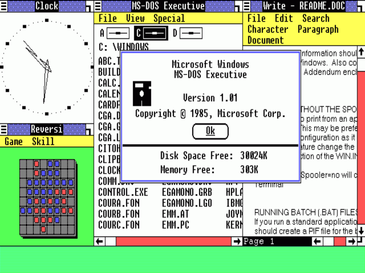
First Retail Version of Microsoft Windows Released
United States
Software Development
Operating Systems
Technology History
4 min read
Updated By: History Editorial Network (HEN)
Published:
Updated:
On 20/11/1985, Microsoft officially released Windows 1.0, the first retail version of the Windows operating system. The product introduced a graphical user interface for IBM compatible personal computers running MS-DOS, allowing users to interact with applications using windows, icons, menus, and a mouse. Windows 1.0 followed an earlier announcement in 1983 and shipped after extended development, targeting systems based on Intel 8086 and 8088 processors with at least 256 KB of memory and two floppy disk drives or a hard disk.
Windows 1.0 did not replace MS-DOS but instead operated as a graphical environment running on top of it. The interface used tiled windows that could not overlap, along with pull down menus, scroll bars, and dialog boxes. Microsoft bundled several applications with the release, including MS-DOS Executive, Calculator, Calendar, Cardfile, Clipboard Viewer, Notepad, Paint, Reversi, Windows Write, and Control Panel. The system also introduced mouse driven interaction to many IBM compatible PCs, which previously relied primarily on keyboard commands.
Although initial adoption was modest, Windows 1.0 established the foundation for later Windows versions. It provided a consistent graphical programming model for developers and demonstrated Microsoft’s long term strategy to move beyond command line computing. Subsequent releases such as Windows 2.0 in 1987 and Windows 3.0 in 1990 expanded graphical capabilities and improved performance, building on the framework introduced in the 1985 release.
#mooflife
#MomentOfLife
#MicrosoftWindows
#Windows1.0
#OperatingSystems
#GraphicalUserInterface
#PersonalComputing
Primary Reference
Windows 1.0

Explore the Life Moments of
 AI Twin