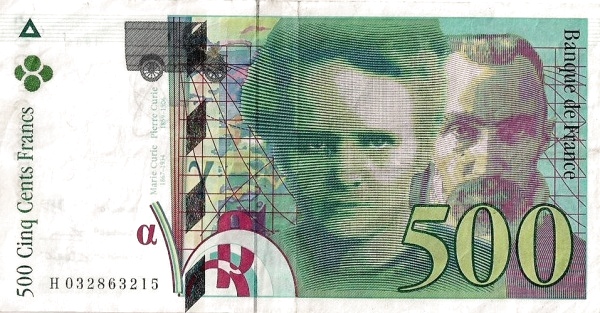
Bank of France honors Curies on new banknote for scientific impact and inspiration.
Poland
Science
Culture
4 min read
Updated By: History Editorial Network (HEN)
Published:
In the mid-1990s, the Bank of France introduced a new 500-franc banknote that prominently featured Marie and Pierre Curie. This decision was a tribute to their groundbreaking contributions to science, particularly in the fields of radioactivity and chemistry. Marie Curie, born in Poland, and her French husband Pierre were instrumental in the discovery of the elements polonium and radium, and their research significantly advanced the understanding of radioactive materials.
The banknote displayed portraits of both Marie and Pierre Curie, coupled with imagery reflecting their scientific achievements. The inclusion of these prominent scientists on the national currency served not only as a recognition of their work but also as an inspiration for future generations engaged in scientific research. The Curies' dedication to their work, despite the personal and professional challenges they faced, exemplified how scientific inquiry could lead to major advancements and societal benefits.
The release of the banknote had multiple layers of impact. Economically, it provided a refreshed and secure form of currency that was resistant to counterfeiting. Culturally, it embedded the Curies' legacy within the everyday lives of French citizens, reminding them of the importance of science and innovation.
Statistically, the presence of high-profile scientists on currency is relatively uncommon, making this banknote a unique representation of the intersection between science, culture, and economy. The note served as both a medium of exchange and an educational tool, highlighting the historical achievements of the Curie family and promoting France’s rich scientific heritage.
#MoofLife #MarieCurie #PierreCurie #France #ScienceInCurrency #EconomicHistory #Chemistry
Primary Reference
France 500 Francs 1994-5 P160 Pierre & Marie Curie VF |
Explore the Life Moments of
 AI Twin