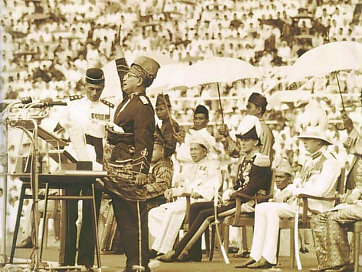
Independence of Federation of Malaya from British colonial rule.
Malaysia

10 min read
Updated By: History Editorial Network (HEN)
Published:
On August 31, 1957, the Federation of Malaya gained independence from British colonial rule, marking a significant moment in the history of Southeast Asia. This event, celebrated as Hari Merdeka or Independence Day, signified the end of British colonialism in Malaya and the beginning of a new chapter for the country as a sovereign nation. The independence of Malaya set the stage for the later formation of Malaysia in 1963.
Background: Colonial Rule and the Road to Independence
The British began to establish control over the Malay Peninsula in the late 18th century, gradually expanding their influence through treaties, direct administration, and the establishment of protectorates over various Malay states. By the early 20th century, the entire peninsula was under British control, either as part of the Federated Malay States, the Unfederated Malay States, or the Straits Settlements.
The Japanese occupation of Malaya during World War II (1941–1945) significantly weakened British authority and stimulated nationalist movements across the region. After the war, the British attempted to reorganize the administration of Malaya through the Malayan Union proposal in 1946, which sought to centralize governance and reduce the political influence of the Malay rulers. However, the Malayan Union faced strong opposition from the Malay population, who viewed it as a threat to their traditional rights and the special position of the Malays.
This opposition led to the formation of the United Malays National Organisation (UMNO) in 1946, led by Dato' Onn Jaafar, which played a pivotal role in rallying the Malay population against the Malayan Union. The British eventually replaced the Malayan Union with the Federation of Malaya in 1948, which provided a more decentralized structure and restored some powers to the Malay rulers.
The Path to Independence
The post-war period saw the rise of nationalist sentiments across Malaya, with growing demands for independence from British rule. The Federation of Malaya's political landscape began to evolve, with the emergence of UMNO as the dominant political force advocating for Malay rights and independence.
In 1951, Tunku Abdul Rahman took over the leadership of UMNO from Dato' Onn Jaafar and pursued a strategy of cooperation with other ethnic groups to achieve independence. This led to the formation of the Alliance Party, a coalition of UMNO, the Malayan Chinese Association (MCA), and the Malayan Indian Congress (MIC), representing the major ethnic communities in Malaya.
The Alliance Party’s success in the 1955 federal elections, where it won 51 out of 52 seats, demonstrated broad support for independence. Following these elections, Tunku Abdul Rahman led a delegation to London in 1956 to negotiate the terms of Malaya’s independence with the British government. The negotiations were successful, leading to an agreement for Malaya to achieve full independence on August 31, 1957.
Independence Day: August 31, 1957
On the morning of August 31, 1957, in a grand ceremony held at Merdeka Stadium in Kuala Lumpur, Tunku Abdul Rahman, who became the first Prime Minister of Malaya, proclaimed the country's independence. In front of a crowd of over 20,000 people, Tunku Abdul Rahman famously shouted "Merdeka!" (meaning "independence" in Malay) seven times, a moment that has since become an iconic symbol of the nation's freedom.
The ceremony was attended by dignitaries from around the world, including representatives from the British government, and was broadcast live to the people of Malaya. The Union Jack was lowered, and the new flag of Malaya was raised, symbolizing the end of British colonial rule and the birth of a new nation.
The Significance of Independence
The independence of the Federation of Malaya was a momentous occasion for the Malay Peninsula and marked the beginning of a new era of self-governance. It was a peaceful transition of power, achieved through negotiation and collaboration between the various ethnic groups within Malaya and the British colonial authorities.
Independence also laid the foundation for the future formation of Malaysia. In 1963, the Federation of Malaya, along with the British colonies of Singapore, Sarawak, and North Borneo (now Sabah), formed the Federation of Malaysia. However, Singapore would later separate from Malaysia in 1965 to become an independent nation.
Legacy and Celebration
Hari Merdeka, or Independence Day, is celebrated annually on August 31 in Malaysia. It is a day of national pride and reflection on the country’s journey to independence and its achievements since. The celebrations typically include parades, fireworks, cultural performances, and the display of the national flag, Jalur Gemilang.
The story of Malaya's independence is a testament to the power of unity and determination in achieving self-determination. It remains a key part of Malaysia's national identity and a reminder of the importance of harmony and cooperation among its diverse population.
#MomentsOfLife #MoofLife_Moment #MoofLife #Malaysia #HariMerdeka #IndependenceDay #PostColonialHistory #SoutheastAsia #NationalIdentity
Primary Reference
Independence Day (Malaysia) - Wikipedia

Explore the Life Moments of
 AI Twin