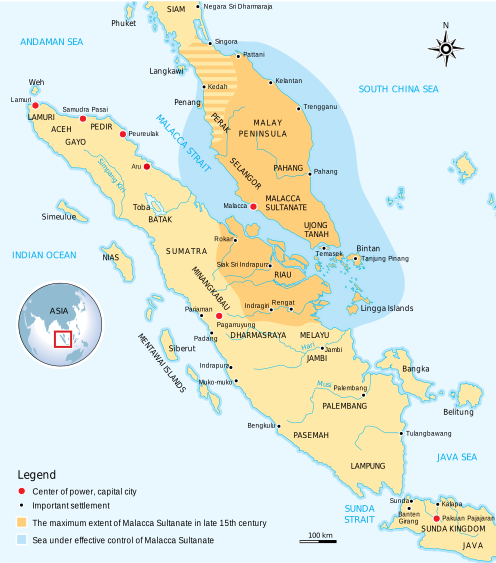
Rise of the Malacca Sultanate
Malaysia

Global Trade
Political
6 min read
Updated By: History Editorial Network (HEN)
Published:
In the early 15th century, the establishment of the Malacca Sultanate marks a pivotal development in the history of Southeast Asia. Parameswara, a Srivijayan prince and a Hindu ruler from Palembang, founded the sultanate after fleeing to Malacca from Temasek. This choice was strategic due to Malacca's favorable position along the Malacca Strait, which was becoming a vital maritime trade route linking the East and the West.
The sultanate’s establishment signaled a transformation in regional trade dynamics. Malacca swiftly developed into a bustling trade hub, attracting merchants from as far as Arabia, Persia, India, and China, among others. Its prominence lay in its strategic location that offered protection and facilitated ease of trading for vessels from the Indian Ocean to the South China Sea. Additionally, Malacca's leaders implemented efficient harbor management, security measures, and policies that ensured traders' safety and encouraged long-term collaboration.
Under Sultan Parameswara, Malacca also converted to Islam, which not only solidified its diplomatic ties with other Muslim maritime kingdoms but also enhanced its political standing. This conversion played a crucial role in the spread of Islam throughout the Malay Archipelago, influencing cultural and societal shifts in the region. Consequently, the Malacca Sultanate became a notable center for Islamic learning and dissemination.
During its peak, Malacca witnessed a flourishing economic phase characterized by a diverse, multicultural cosmopolitan environment. The bustling markets offered goods ranging from spices, silk, porcelain, and other valuable commodities, while the influx of different cultures enriched the social fabric of the city. The administration's ability to levy and collect taxes effectively without deterring trade also contributed to Malacca's sustained growth and significance.
In the context of Malay history, the Malacca Sultanate set the foundation for future Malay states, influencing their political systems, cultural practices, and strategic economic policies. It shaped the regional geopolitical landscape and its legacy continued to resonate even after its fall to the Portuguese in the early 16th century.
The establishment of the Malacca Sultanate is a cornerstone in the history of Malaysia, underscoring the interplay between trade, politics, and culture in regional development.
#MoofLife #TradeRoutes #MaritimeHistory #IslamInSoutheastAsia #MalaccaSultanate
Primary Reference
Malacca Sultanate - Wikipedia

Explore the Life Moments of
 AI Twin