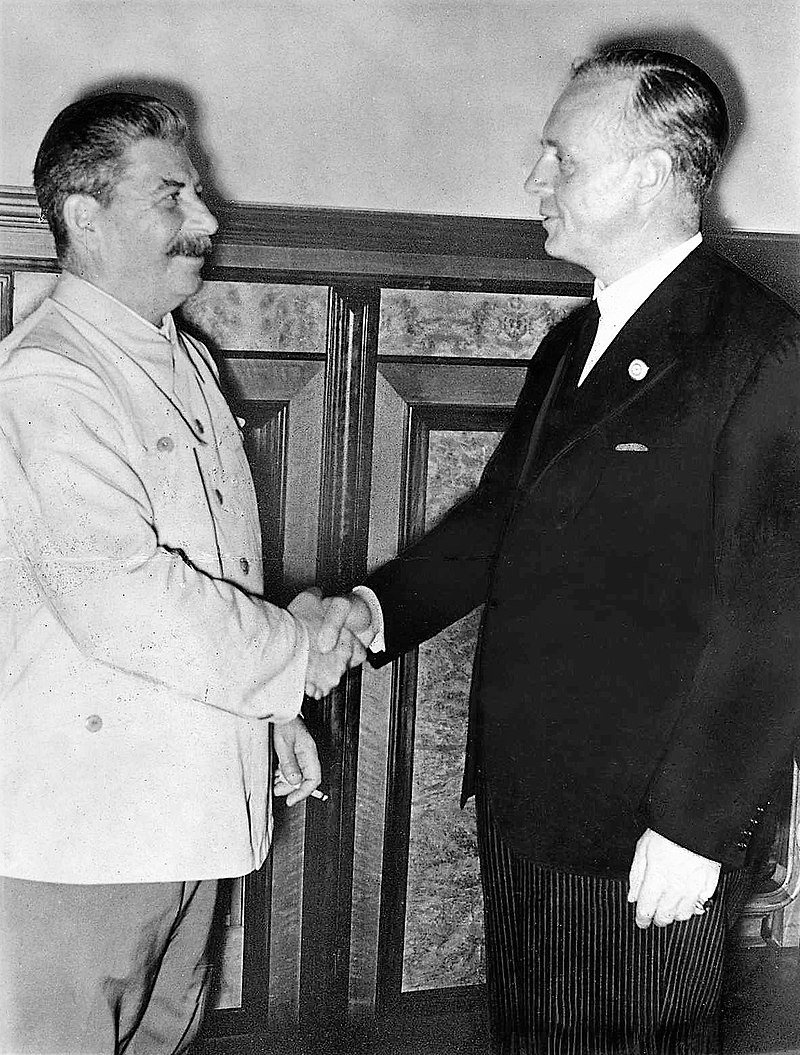
Stalin Meets German Foreign Minister Ribbentrop
Russia
Politics
World War II
4 min read
Updated By: History Editorial Network (HEN)
Published:
Updated:
The meeting between Joseph Stalin and German Foreign Minister Joachim von Ribbentrop marked a pivotal moment in the diplomatic relations between the Soviet Union and Nazi Germany. Following the replacement of Maxim Litvinov with Vyacheslav Molotov as the Soviet Foreign Minister, negotiations began between the two nations. The discussions centered around the division of Eastern Europe, reflecting the strategic interests of both powers. The culmination of these negotiations was the signing of the Molotov-Ribbentrop Pact, a nonaggression treaty that assured both countries would not attack each other and included secret protocols for the division of territories in Eastern Europe. This agreement allowed Germany to invade Poland without fear of Soviet intervention, effectively leading to the outbreak of World War II.
The impact of the pact was profound, as it altered the geopolitical landscape of Europe. The Soviet Union gained significant territories in Eastern Europe, including parts of Poland, the Baltic States, and Finland. This expansion was crucial for the USSR's strategic depth and security. The pact also facilitated the initial phase of the war for Germany, allowing it to focus its military efforts on the West without the threat of a two-front war. The collaboration between the two regimes, despite their ideological differences, demonstrated a pragmatic approach to power politics. The Molotov-Ribbentrop Pact remained in effect until Germany's invasion of the Soviet Union, which ultimately shifted the dynamics of the war and led to a fierce conflict between the two former allies.
#mooflife
#MomentOfLife
#Stalin
#Ribbentrop
#Molotov-ribbentropPact
#SovietUnion
#NaziGermany
Primary Reference
Molotov–Ribbentrop Pact

Explore the Life Moments of
 AI Twin