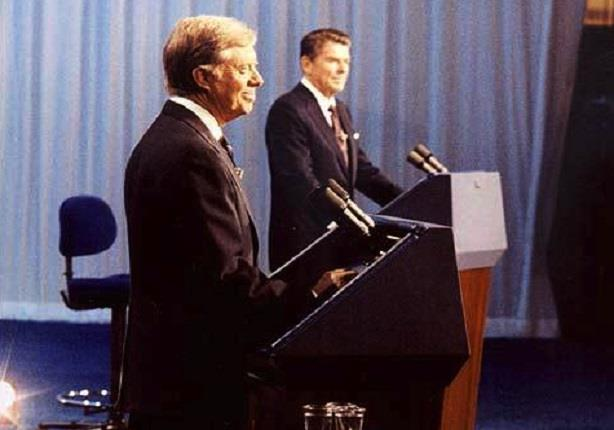
Presidential Debate between Carter and Reagan in Cleveland
10 min read
Updated By: History Editorial Network (HEN)
Published:
On October 28, 1980, President Jimmy Carter and former California Governor Ronald Reagan faced off in a highly anticipated presidential debate in Cleveland, Ohio. This was the only debate between the two candidates during the 1980 election campaign, and it took place just one week before Election Day. The debate was a defining moment in the election, providing voters with a clear contrast between Carter’s defense of his record and Reagan’s optimistic vision for America’s future.
Background: A Pivotal Moment in the Election
By the time of the debate, the country was facing significant economic and geopolitical challenges. The Iran hostage crisis, which had begun in November 1979, was still unresolved, and the economy was suffering from stagflation—a combination of high inflation, high unemployment, and slow economic growth. These issues had severely impacted Carter’s popularity, and Reagan, the Republican nominee, was gaining momentum with his message of economic revival and strong leadership.
Carter entered the debate needing a strong performance to sway undecided voters, while Reagan aimed to reassure the public that he was not the radical or risky choice some of his critics had portrayed him to be.
Key Issues and Highlights
Several major topics dominated the debate, including the economy, national security, and foreign policy.
The Economy: The economy was the central issue, with Carter defending his administration’s efforts to combat inflation and unemployment. He emphasized the global nature of the economic downturn and highlighted his policies aimed at creating jobs and reducing energy dependence. Carter also portrayed Reagan’s economic proposals, particularly his plan for large tax cuts, as irresponsible and likely to increase inflation and the national debt.
Reagan, in contrast, attacked Carter’s economic record, arguing that Americans were worse off than they had been four years earlier. He criticized Carter for high inflation rates and unemployment, offering a plan of tax cuts, deregulation, and reduced government spending as a way to stimulate growth. Reagan’s famous question during the debate, aimed directly at voters, became one of the most memorable moments:
"Are you better off than you were four years ago?"
This question resonated with many Americans who were frustrated with the economic difficulties they were experiencing, and it framed the election as a referendum on Carter’s leadership.
National Security and Foreign Policy: The ongoing Iran hostage crisis was a critical issue during the debate. Carter sought to position himself as the more experienced candidate on foreign policy, emphasizing the complexities of the crisis and his ongoing efforts to secure the hostages' release. He warned that Reagan’s more aggressive stance on foreign policy could lead to increased tensions or even war.
Reagan, on the other hand, criticized Carter’s handling of the hostage crisis and broader foreign policy, arguing that America had lost its influence and respect on the world stage under Carter’s leadership. He advocated for a stronger national defense and a more assertive posture in confronting adversaries, particularly the Soviet Union. Reagan rejected Carter’s implication that his policies would lead to war, famously responding:
"I don’t think President Carter has ever really understood what my military strategy is. I believe that a credible defense is essential to prevent war."
Leadership and Vision: Throughout the debate, Reagan presented himself as a calm, confident, and optimistic leader, contrasting his style with Carter’s more detailed and often critical approach. Reagan’s demeanor helped him dispel fears that he was too extreme or unprepared to handle the presidency. His closing statement, in particular, was a direct appeal to voters’ desire for change, emphasizing unity and hope for the future:
"I think when you make that decision, it might be well if you would ask yourself: Are you better off than you were four years ago? Is it easier for you to go and buy things in the stores than it was four years ago? Is there more or less unemployment in the country than there was four years ago? Is America as respected throughout the world as it was? Do you feel that our security is as safe, that we're as strong as we were four years ago? And if you answer all of those questions 'yes,' why then, I think your choice is very obvious as to who you'll vote for. If you don't agree, if you don't think that this course that we've been on for the last four years is what you would like to see us follow for the next four, then I could suggest another choice that you have."
This closing statement, along with his overall performance, reinforced Reagan’s image as a candidate offering a new direction for the country.
Impact and Aftermath
The debate proved to be a turning point in the 1980 presidential race. Reagan’s performance was widely viewed as more confident and composed, helping to solidify his image as a strong, capable leader. His ability to effectively counter Carter’s attacks and offer a positive, forward-looking vision for America resonated with many voters.
In contrast, Carter’s focus on defending his record and attacking Reagan’s policies did not have the desired effect. His emphasis on the complexities of governance and the dangers of Reagan’s proposals may have come across as overly negative or defensive to many viewers, especially in comparison to Reagan’s more optimistic tone.
Polls conducted after the debate showed a significant shift in Reagan’s favor, and he ultimately won the election in a landslide on November 4, 1980, carrying 44 states and securing 489 electoral votes to Carter’s 49. The debate was a critical moment in Reagan’s victory, helping him to solidify his lead in the final days of the campaign.
#ReaganVsCarter #PresidentialDebate #1980Election #JimmyCarter #RonaldReagan #USHistory #Stagflation #MomentsOfLife #MoofLife_Moment #MoofLife
Primary Reference
1980 Ronald Reagan and Jimmy Carter Presidential Debate ...
Explore the Life Moments of
 AI Twin