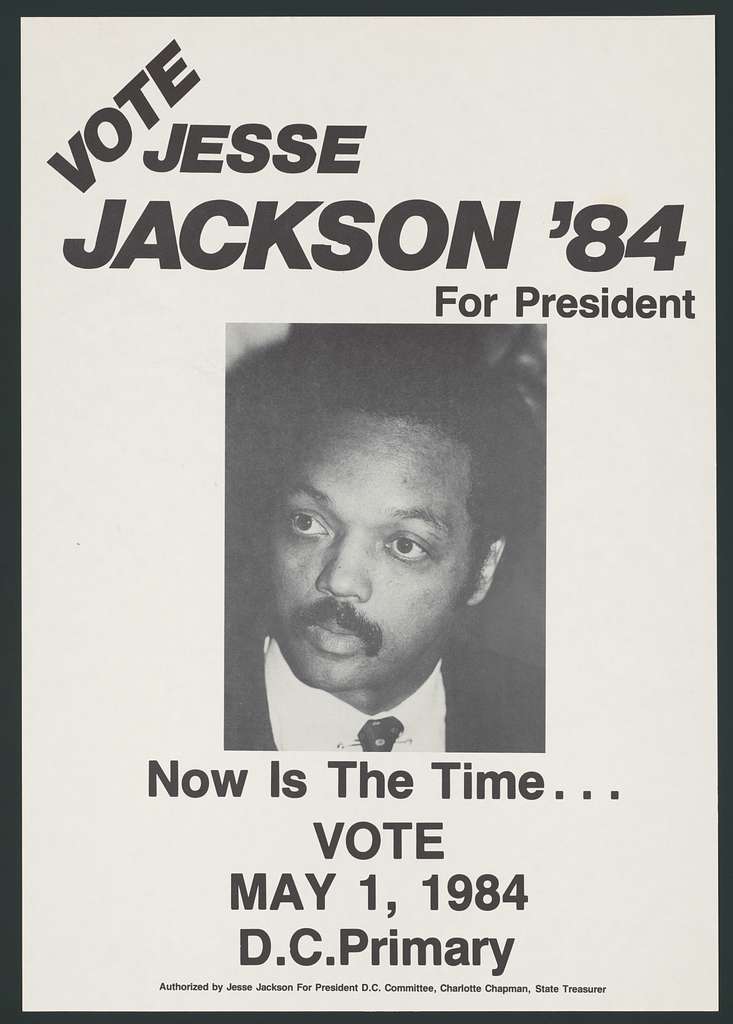
Launched his first presidential campaign, finishing third for the Democratic nomination.
United States of America
7 min read
Updated By: History Editorial Network (HEN)
Published:
In 1984, Jesse Jackson made history by launching his first presidential campaign, becoming the first African American candidate to mount a serious bid for a major party's nomination. His campaign was rooted in his vision of a "Rainbow Coalition," which aimed to unite diverse groups, including African Americans, Latinos, Native Americans, laborers, the poor, and other marginalized communities. Jackson’s candidacy not only expanded the Democratic Party’s appeal to these groups but also pushed progressive issues into the national political discourse.
Jackson announced his candidacy on November 3, 1983, at a time when the Democratic Party was fragmented, following Ronald Reagan’s sweeping victory in the 1980 presidential election. Jackson’s platform addressed economic inequality, racial justice, and social reforms. His key policy proposals included raising the minimum wage, increasing access to education and healthcare, reducing military spending, and standing against apartheid in South Africa.
Despite limited initial support from the Democratic establishment, Jackson's campaign gained momentum. His strong oratory skills, rooted in his background as a Baptist minister and civil rights leader, resonated with a broad base of voters. He campaigned in rural areas, urban centers, and college campuses, often drawing large, enthusiastic crowds. Jackson’s emphasis on empowering disenfranchised voters was particularly appealing to African Americans, who turned out in record numbers in some states to support him.
One of the most memorable moments of Jackson’s 1984 campaign came during the primaries, when he won several key contests, including those in Louisiana, South Carolina, Virginia, and the District of Columbia. In total, Jackson secured over 3 million votes (about 18% of the total vote), won five primaries and caucuses, and finished third behind former Vice President Walter Mondale and Colorado Senator Gary Hart. His performance was remarkable for a candidate without the traditional support of the Democratic Party’s elite or major financial backing.
However, Jackson's campaign was not without controversy. In addition to facing skepticism from some Democratic leaders, Jackson's campaign was hurt by the fallout from his "Hymietown" remark, an anti-Semitic slur referring to New York City’s Jewish community. Though he apologized, the comment strained relations between Jackson and many Jewish voters, a key Democratic constituency.
Despite these challenges, Jackson’s 1984 run was groundbreaking. His success demonstrated that an African American candidate could compete on the national stage, laying the groundwork for future candidates of color. Additionally, Jackson’s campaign had a lasting impact on the Democratic Party, as it energized and mobilized African American and progressive voters in ways that had not been seen before. His Rainbow Coalition expanded the political imagination of what a Democratic Party constituency could look like, promoting a vision of inclusivity that has shaped the party’s platform in the decades since.
Although he did not win the Democratic nomination, Jackson’s third-place finish was historic, and he vowed to continue pushing for social justice and equality. He would return to the political stage in 1988, with an even more successful presidential run.
#JesseJackson #1984PresidentialCampaign #RainbowCoalition #CivilRights #DemocraticPrimary #HistoricCampaign #MomentsOfLife #MoofLife_Moment #MoofLife
Primary Reference
Jesse Jackson - Wikipedia
Explore the Life Moments of
 AI Twin