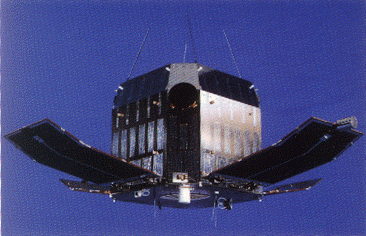
Tenma satellite launched for x-ray research
Japan

Science
Global Trade
4 min read
Updated By: History Editorial Network (HEN)
Published:
In 2/20/1983, the successful launch of the Tenma satellite marked a significant advancement in Japan's space exploration efforts. Named after a celestial maiden in Japanese folklore, Tenma aimed to study cosmic x-rays, shedding light on high-energy phenomena such as black holes and neutron stars.
Equipped with cutting-edge x-ray detectors, Tenma orbited the Earth, gathering crucial data on celestial bodies emitting x-rays. This information provided scientists with valuable insights into the behavior and composition of these enigmatic objects, contributing to our understanding of the universe's intricacies.
The successful deployment of Tenma bolstered Japan's reputation in the global space community and demonstrated the nation's growing capabilities in space research. The mission also paved the way for future Japanese satellite projects, solidifying Japan's position as a key player in space exploration.
The impact of Tenma's mission extended beyond national boundaries, as its findings were shared with the international scientific community, fostering collaboration and knowledge exchange. Scientists worldwide benefitted from the wealth of data gathered by Tenma, further enriching our collective understanding of the cosmos.
The Tenma satellite's legacy endures in the annals of space exploration, serving as a testament to Japan's commitment to pushing the boundaries of scientific discovery. Its contributions to the field of x-ray astronomy continue to inspire and inform ongoing research efforts aimed at unraveling the mysteries of the universe.
#TenmaSatellite #JapanSpaceExploration #XRayAstronomy #ScientificDiscovery

Explore the Life Moments of
 AI Twin