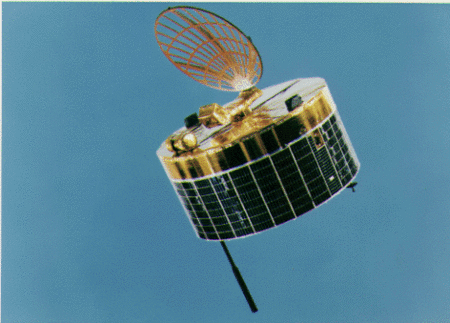
Japanese Probe Planet A to Halley's Comet
Japan

Science
Technology
4 min read
Updated By: History Editorial Network (HEN)
Published:
In 8/8/1985, Japan achieved a remarkable feat in space exploration by launching the 'Planet A' probe towards Halley's comet. The project marked Japan's entry into the elite club of nations capable of deep space exploration.
The probe was equipped with advanced scientific instruments to study the composition, structure, and behavior of Halley's comet, providing crucial insights into the origins of the solar system. It carried out extensive observations during its journey, relaying valuable data back to Earth.
The successful launch of 'Planet A' showcased Japan's growing prowess in space technology and its commitment to advancing scientific knowledge. It demonstrated the country's ability to undertake complex interplanetary missions and contribute meaningfully to the global space exploration efforts.
The data gathered by the probe not only added to humanity's understanding of comets and their role in the universe but also paved the way for future missions to study celestial bodies beyond Earth's immediate vicinity.
The launch of 'Planet A' marked a significant milestone in Japan's space exploration endeavors, underscoring the nation's dedication to pushing the boundaries of scientific discovery and technological innovation. It highlighted Japan's strategic investments in space research and its emergence as a key player in the international space community.
The success of the 'Planet A' mission inspired a new generation of scientists and engineers in Japan, sparking further interest and investment in space exploration initiatives. It solidified Japan's reputation as a formidable player in the global space race and set the stage for future ambitious missions to unravel the mysteries of the cosmos.
#JapanSpaceExploration #HalleyCometProbe #ScientificDiscovery

Explore the Life Moments of
 AI Twin