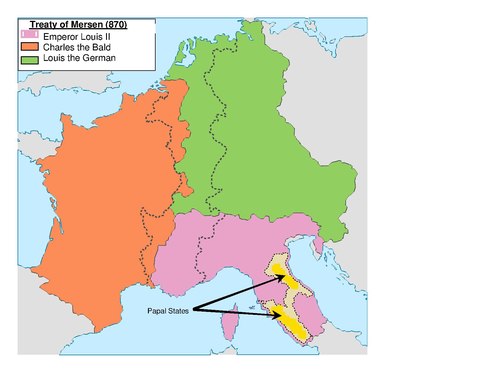
Treaty of Meerssen divides Carolingian Empire into smaller territories after signing in 870.
Italy
Political
3 min read
Updated By: History Editorial Network (HEN)
Published:
The Treaty of Meerssen, a pivotal event in the history of the Carolingian Empire, resulted in the division of the territory once again among the heirs of Emperor Louis the Pious following years of power struggles and conflicts. The treaty was signed to end the strife between Louis' grandsons, Charles the Bald and Louis the German, both vying for control over the empire. The division of the Carolingian Empire through the Treaty of Meerssen had a profound impact on the political landscape of Europe. The treaty solidified the split between Western Francia, ruled by Charles the Bald, and Eastern Francia, under the rule of Louis the German. Furthermore, Middle Francia was also created, with Lothair I as its ruler. The division of the Carolingian Empire not only altered the political boundaries of the region but also laid the groundwork for the rise of various feudal kingdoms and principalities. This fragmentation weakened the overall authority of the Carolingian rulers and paved the way for the eventual dissolution of the empire. The Treaty of Meerssen marked a turning point in the history of the Carolingian Empire, setting the stage for the eventual decline of Carolingian power and the emergence of new kingdoms in Europe. This event played a significant role in shaping the medieval political landscape and influencing the course of European history for centuries to come. #TreatyofMeerssen #CarolingianEmpire #DivisionofTerritory #FeudalKingdoms #MedievalHistory #PoliticalLandscape
Primary Reference
Charles II "the Bald", Western Emperor

Explore the Life Moments of
 AI Twin