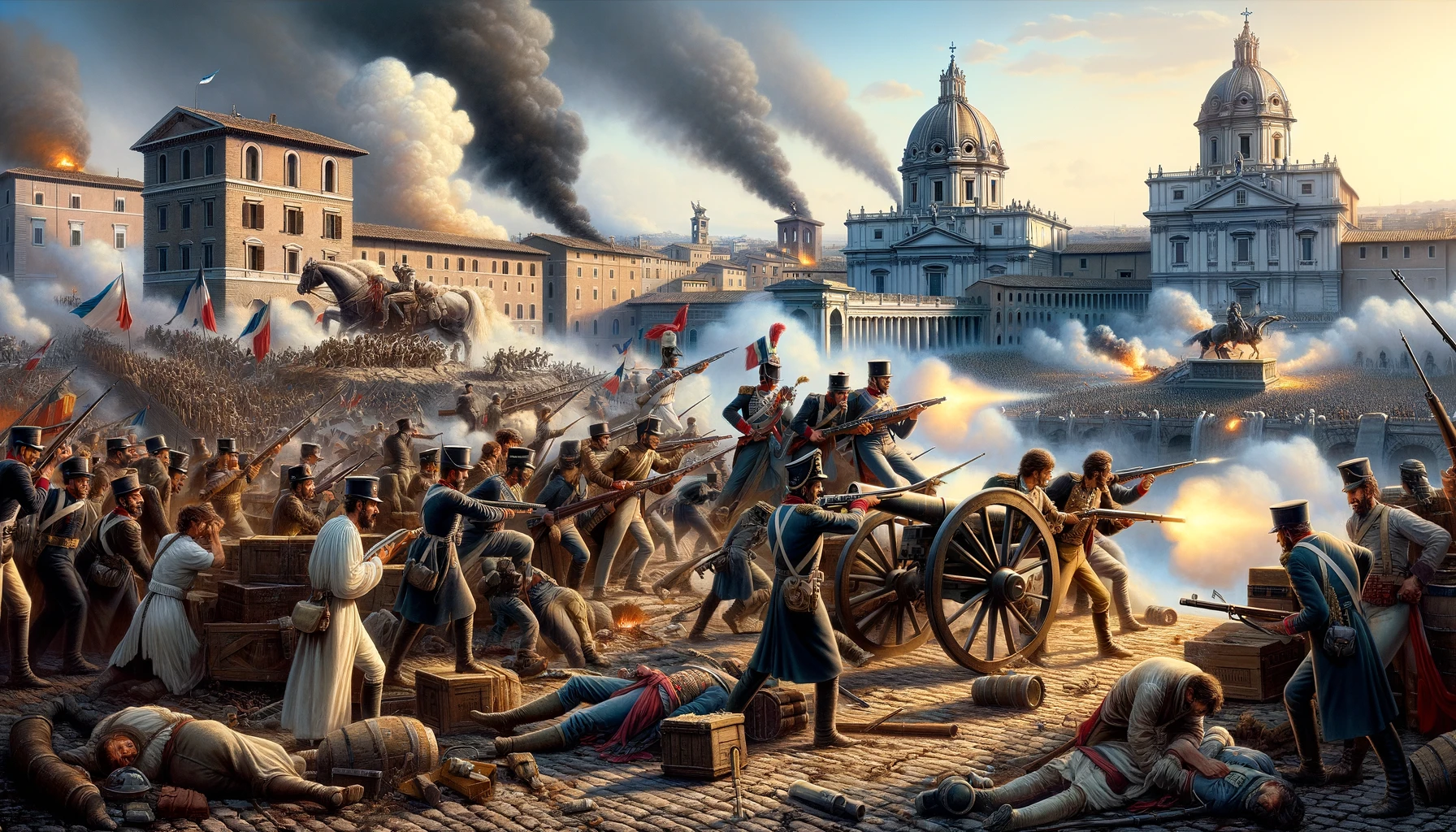
French forces' Siege of Rome.
Italy
Political
8 min read
Updated By: History Editorial Network (HEN)
Published:
On June 1, 1849, the French forces began their decisive siege on Rome, marking a significant episode in the broader context of the Italian unification and the revolutionary upheavals sweeping through Europe during the mid-19th century. This military conflict culminated in the fall of the short-lived Roman Republic and the restoration of the Papal States.
The Roman Republic had been established in February 1849 after Pope Pius IX fled Rome in response to a popular uprising. Inspired by the broader revolutionary fervor of the time, which saw uprisings in France, Germany, and the Austrian Empire, the Roman populace, along with Italian nationalists, sought to overthrow the papal government and establish a republic.
Key figures in this movement included Giuseppe Mazzini, a leading Italian nationalist and republican who became one of the Republic's triumvirs, and Giuseppe Garibaldi, a charismatic military leader renowned for his efforts in the cause of Italian unification. Mazzini envisioned a unified Italy as a democratic republic, free from foreign domination and internal despotism.
The Roman Republic quickly implemented progressive reforms, including the abolition of the death penalty, freedom of the press, and the establishment of secular education. However, the fledgling republic faced immense external pressure. Pope Pius IX appealed to Catholic monarchies in Europe to restore his temporal power, leading to intervention by French, Austrian, Spanish, and Neapolitan forces.
The French, under President Louis-Napoléon Bonaparte (the future Emperor Napoleon III), had vested interests in maintaining the Pope's rule, both to gain favor with French Catholics and to assert France's influence in Italy. Consequently, an expeditionary force was dispatched to Rome under the command of General Nicolas Oudinot.
The initial French assault on Rome in late April 1849 was repelled by Garibaldi's forces, who displayed remarkable defensive prowess. However, the French regrouped and launched a more concerted siege beginning on June 1. This time, they were better prepared and significantly reinforced.
The siege saw intense fighting, with Garibaldi leading a spirited but ultimately doomed defense. Despite the Roman Republic's valiant resistance, the superior numbers and artillery of the French forces gradually wore down the defenders. The French bombardment caused extensive damage to the city's fortifications and inflicted heavy casualties on both sides.
By the end of June, the situation inside Rome had become untenable. On June 30, after weeks of relentless siege and facing the inevitable, the Roman Assembly voted to surrender. The French entered Rome on July 3, 1849, effectively bringing an end to the Roman Republic.
The fall of Rome marked a significant setback for the Italian nationalist movement. However, it was not the end of the struggle for Italian unification. The ideals of the Roman Republic and the heroism of figures like Mazzini and Garibaldi continued to inspire Italian nationalists. Garibaldi, in particular, became a symbol of resistance and would later play a crucial role in the unification of Italy.
The French siege of Rome and the subsequent restoration of papal authority underscored the complex interplay of revolutionary ideals, nationalist aspirations, and international diplomacy that characterized the 19th-century European political landscape. While the immediate outcome was a defeat for the republicans, the seeds of Italian unification had been sown, ultimately leading to the establishment of a unified Italy in 1861.
#MomentsOfLife #MoofLife_Moment #MoofLife #ItalianUnification #RomanRepublic #FrenchSiege #Garibaldi #Mazzini #PapalStates #19thCenturyHistory
Primary Reference
Siege of Rome | Summary | Britannica

Explore the Life Moments of
 AI Twin