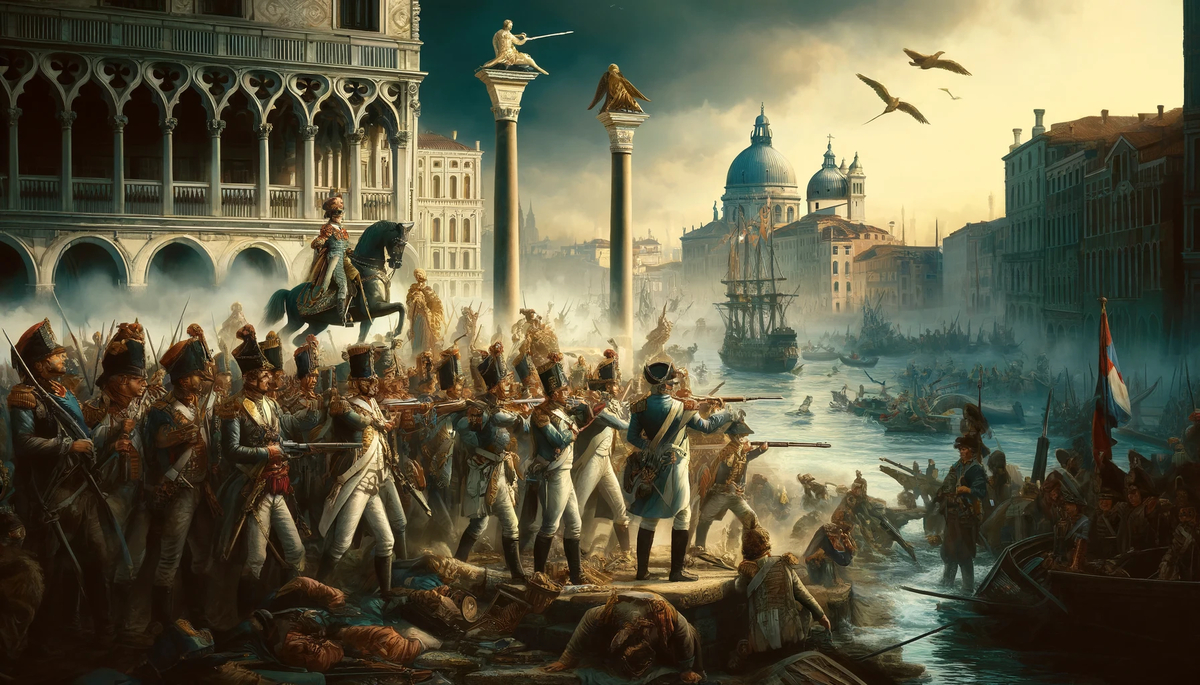
Fall of the Republic of Venice.
Italy
Conflicts
War
6 min read
Updated By: History Editorial Network (HEN)
Published:
The fall of Venice on May 12, 1797, signified the dramatic end of a republic that had thrived as a maritime power for over a thousand years. Renowned for its strategic location on the Adriatic Sea and its robust trade networks, the Republic of Venice once stood as a beacon of commerce and culture, flourishing through diplomacy, naval prowess, and a mercantile economy that connected Europe with the East.
By the late 18th century, however, Venice's power was waning. The republic had grown complacent and lost its former strategic edge as rival European powers rose. Technological advancements, changing trade routes, and emerging empires threatened Venice's dominance. But it was the aggressive expansion of Revolutionary France under Napoleon Bonaparte that precipitated Venice's rapid decline.
In the spring of 1797, Napoleon's forces, backed by modern military tactics, pushed into Italy with remarkable speed. They decimated the Venetian military, which was largely outmoded and unprepared for this new style of warfare. Facing internal unrest and lacking allies, the Venetian government could not withstand the French invasion. Napoleon capitalized on these vulnerabilities, portraying Venice as a tyrannical state that oppressed its people. This propaganda helped justify his actions and rally support for the French cause.
The Treaty of Campo Formio, signed on October 17, 1797, formally sealed Venice's fate. Napoleon ceded the city and its territories to the Austrian Empire, recognizing their control over much of northern Italy. The once-great republic was dismantled, its institutions dissolved, and its sovereignty shattered. Venice became part of the Austrian domain, signaling an irreversible shift in the power dynamics of Europe.
The fall of Venice was a tragic moment in European history, marking the demise of a city that had been at the forefront of global trade and diplomacy. It brought about a significant reconfiguration of borders, as Venice's former territories were carved up and redistributed among the victorious powers. The bustling city that had once stood as a pinnacle of commerce and civilization now faded into relative obscurity.
Despite its political demise, Venice's legacy endured. Its unique cultural heritage, reflected in its stunning art and architecture, continues to captivate the world. Visitors still marvel at landmarks like the Basilica di San Marco, the Doge's Palace, and the intricate canals that weave through the city. The fall of Venice serves as a poignant reminder of the transience of power and the rapid changes that swept Europe during this tumultuous period.
#FallOfVenice #Napoleon #TreatyOfCampoFormio #EndOfAnEra #VenetianRepublic #MomentsOfLife #MoofLife_Moment #MoofLife
Primary Reference
Fall of the Republic of Venice - Wikipedia

Explore the Life Moments of
 AI Twin