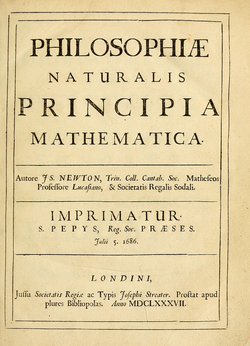
Publication of the Principia in 1687
Science
Mathematics
4 min read
Updated By: History Editorial Network (HEN)
Published:
Updated:
The publication of the Principia marked a pivotal moment in the history of science, as it introduced Sir Isaac Newton's three universal laws of motion. These laws fundamentally describe the relationship between an object and the forces acting upon it, providing a framework for understanding motion in the physical world. The first law, often referred to as the law of inertia, states that an object at rest will remain at rest, and an object in motion will continue in motion at a constant velocity unless acted upon by a net external force. The second law establishes a quantitative relationship between force, mass, and acceleration, encapsulated in the formula F=ma. The third law asserts that for every action, there is an equal and opposite reaction, highlighting the interactions between objects. The work was made possible through the encouragement and financial support of astronomer Edmond Halley, who recognized the significance of Newton's findings and played a crucial role in its publication. The impact of the Principia was profound, as it laid the groundwork for classical mechanics and influenced countless fields, including physics, engineering, and astronomy. It provided a systematic approach to understanding motion and forces, which would later be essential for advancements in technology and the natural sciences. The principles outlined in the Principia not only transformed scientific thought but also established a new standard for empirical research and mathematical rigor in the study of the natural world.
#mooflife
#MomentOfLife
#Newton
#Principia
#LawsOfMotion
#ClassicalMechanics
#ScientificRevolution
Primary Reference
Philosophiæ Naturalis Principia Mathematica

Explore the Life Moments of
 AI Twin