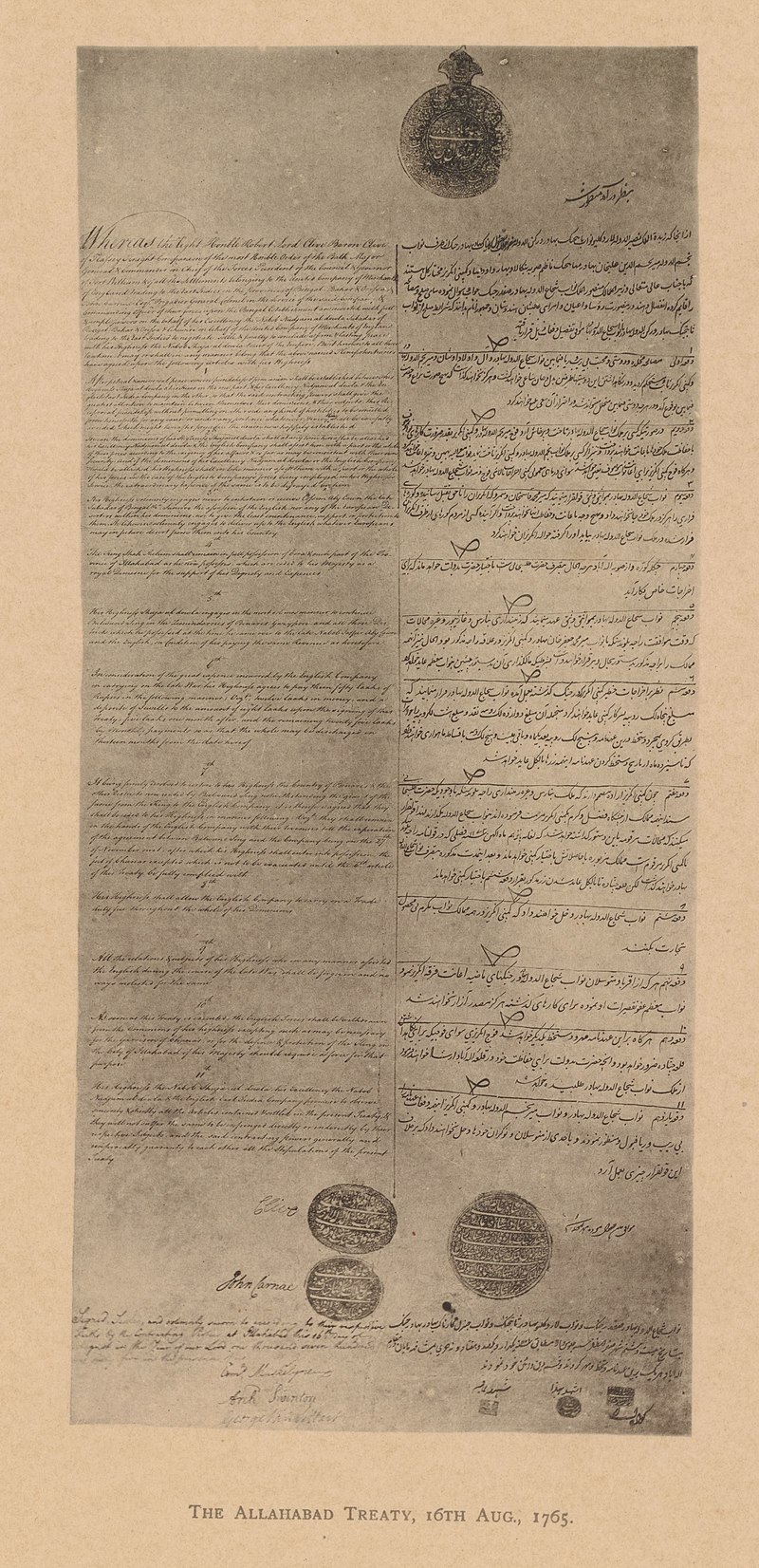
Treaty of Allahabad: Shah Alam II and British East India Company agreement.

Political
4 min read
Updated By: History Editorial Network (HEN)
Published:
During the Treaty of Allahabad, the Mughal Emperor Shah Alam II and the British East India Company formalized an agreement that altered the course of Indian history. It came at a time when the once-powerful Mughal Empire was in decline, and the British were steadily expanding their influence across the subcontinent. The treaty granted the East India Company the diwani rights, enabling them to collect revenue in the provinces of Bengal, Bihar, and Orissa.
The treaty marked a significant shift in power dynamics, as it effectively placed the Company in a position of economic authority over a vast territory, while the Mughal Emperor retained nominal sovereignty. With the diwani rights, the Company gained immense financial control, further strengthening its grip on the region. This paved the way for British colonial rule in India, as they gradually extended their dominion over other parts of the country.
Additionally, the Treaty of Allahabad led to a resurgence of the East India Company's influence in India, solidifying their position as a dominant force in the subcontinent. It also highlighted the deteriorating power of the Mughal Empire, which had once been a formidable political entity in the region. The treaty's repercussions reverberated throughout Indian history, shaping the trajectory of British colonization and the eventual struggle for independence.
In conclusion, the Treaty of Allahabad was a pivotal moment that marked the ascendance of the British East India Company in India and the decline of the Mughal Empire. It set the stage for British colonial rule and fundamentally altered the socio-political landscape of the subcontinent. #TreatyofAllahabad #BritishEastIndiaCompany #MughalEmpire #IndianHistory

Explore the Life Moments of
 AI Twin