First Anglo-Afghan War

10 min read
Updated By: History Editorial Network (HEN)
Published:
The First Anglo-Afghan War (1839-1842) was a significant conflict between the British East India Company and the Emirate of Afghanistan. This war marked the beginning of what would become known as the "Great Game," the strategic rivalry between the British and Russian Empires for dominance in Central Asia. The war's outcome highlighted the challenges and complexities of imperial ambitions in the rugged and fiercely independent terrain of Afghanistan.
Background
In the early 19th century, British India was a growing colonial power in the region, and the British were increasingly concerned about Russian expansion towards Central Asia. Afghanistan, situated between British India and the Russian Empire, became a focal point of strategic interest. The British feared that a pro-Russian Afghanistan would threaten their Indian possessions.
The Prelude to War
To counter Russian influence, the British decided to replace the Afghan ruler Dost Mohammad Khan with Shah Shujah Durrani, a former ruler who had been dethroned and was living in exile in India. The British believed that Shah Shujah would be a more pliable ally. In 1839, a British expeditionary force, known as the Army of the Indus, invaded Afghanistan to install Shah Shujah on the throne.
Key Figures
Dost Mohammad Khan: The reigning Emir of Afghanistan, known for his strong leadership and efforts to modernize his army.
Shah Shujah Durrani: The British-backed former ruler of Afghanistan, whom the British sought to reinstate.
Major-General William Elphinstone: The British commander whose leadership would be called into question during the campaign.
Major Battles and Events
Invasion and Initial Success
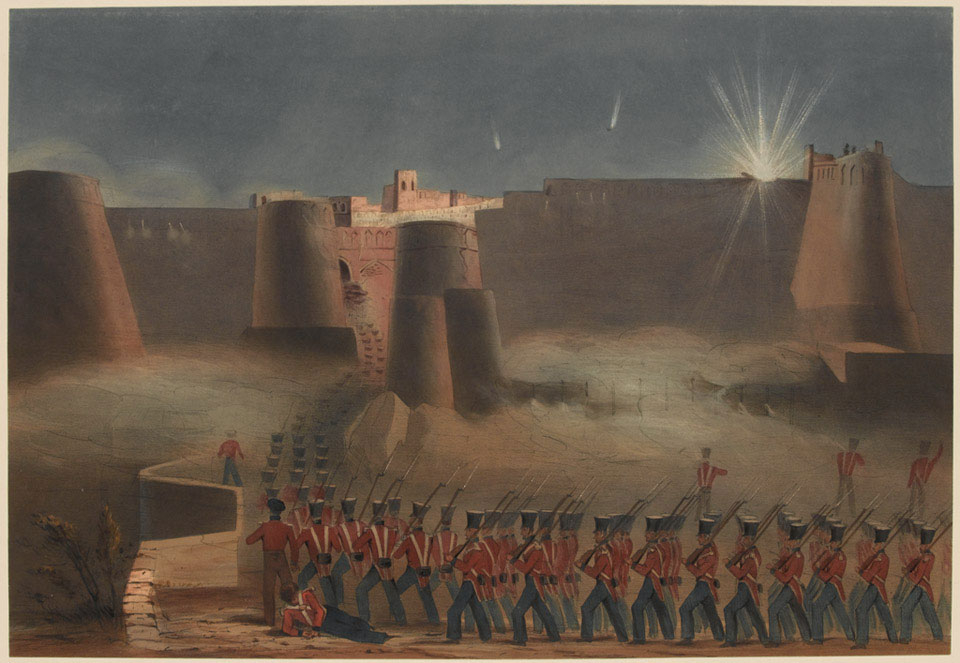
In March 1839, the British forces, composed of around 21,000 soldiers, crossed the Bolan Pass and advanced into Afghanistan. By July, they had captured the fortress of Ghazni, a key victory that allowed them to proceed to Kabul. Shah Shujah was installed as the ruler of Afghanistan in August 1839, seemingly achieving British objectives.
The Occupation of Kabul
The British maintained a garrison in Kabul to support Shah Shujah's regime. However, the occupation was costly and increasingly unpopular. Afghan resentment towards the British presence grew, exacerbated by economic difficulties and political tensions.
Uprising and Disaster
In November 1841, a general uprising against the British garrison in Kabul began. The rebellion was fueled by widespread dissatisfaction with Shah Shujah's rule and British interference. The British garrison, under the command of Major-General William Elphinstone, was ill-prepared for the scale of the insurrection.
In January 1842, facing mounting pressure and deteriorating conditions, Elphinstone agreed to evacuate Kabul under a negotiated agreement that promised safe passage. However, as the British force of about 4,500 soldiers and 12,000 camp followers attempted to retreat through the snowbound passes towards Jalalabad, they were ambushed and harassed by Afghan tribesmen.
The Retreat from Kabul
The retreat turned into a catastrophic disaster. Harsh winter conditions, inadequate supplies, and relentless attacks decimated the retreating column. Almost the entire British force was annihilated, with only one British soldier, Dr. William Brydon, managing to reach Jalalabad alive to tell the tale.
Aftermath and Consequences
The massacre of the British retreating forces from Kabul shocked Britain and prompted a swift military response. The British launched a punitive expedition to avenge their losses, recapturing Kabul in September 1842 and exacting retribution on the Afghans. However, recognizing the futility of their position, the British decided to withdraw from Afghanistan entirely by the end of the year.
The First Anglo-Afghan War highlighted the difficulties of military campaigns in Afghanistan's harsh terrain and the resilience of its people. The war also underscored the limits of imperial power and the complexities of imposing foreign rule on a fiercely independent nation.
Legacy
The First Anglo-Afghan War is remembered as a significant episode in the history of British imperialism and Afghan resistance. It demonstrated the formidable challenges of intervening in Afghanistan and served as a cautionary tale for future military engagements in the region. The conflict also set the stage for ongoing geopolitical rivalries in Central Asia, known as the "Great Game," which continued to shape the region's history.
#MomentsOfLife #MoofLife_Moment #MoofLife #FirstAngloAfghanWar #BritishIndia #AfghanHistory #GreatGame #ColonialHistory #MilitaryHistory #HistoricalEvents
Explore the Life Moments of
 AI Twin