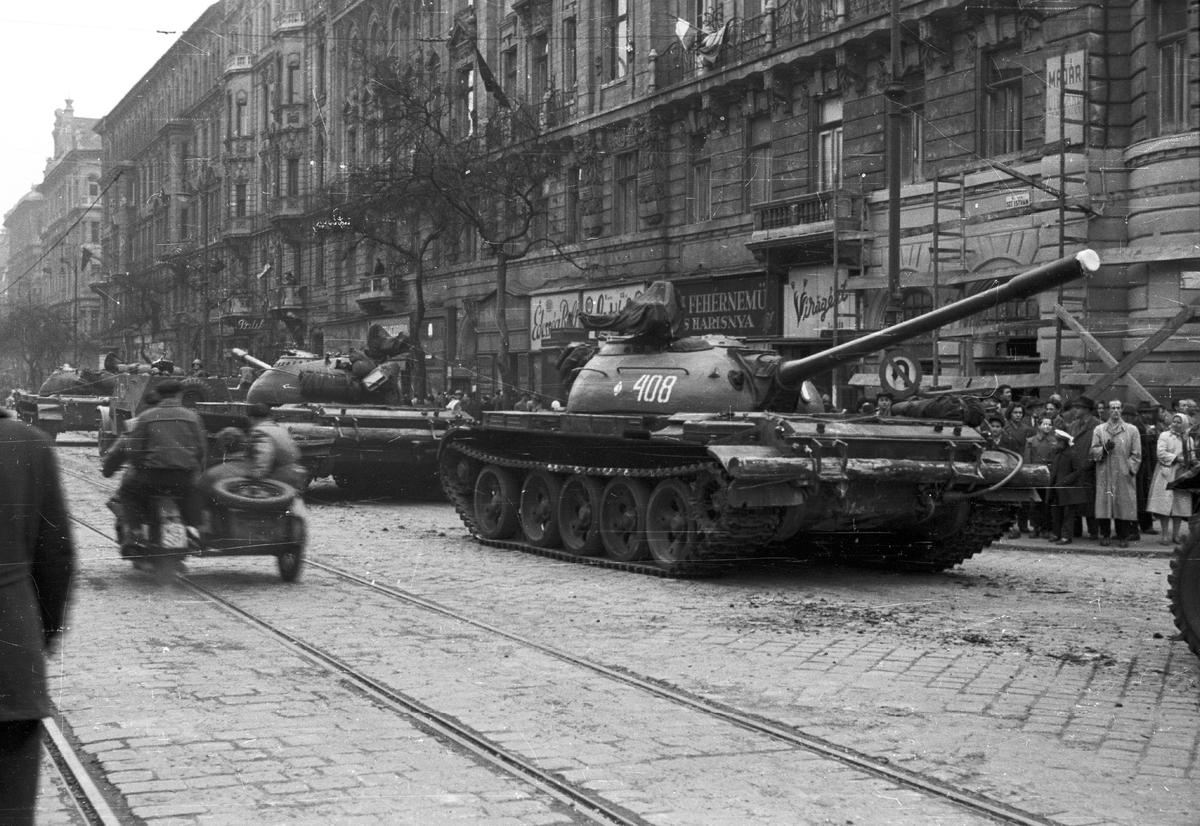
Soviet Forces Suppress Revolution
Hungary
Political
Global Trade
5 min read
Updated By: History Editorial Network (HEN)
Published:
In the mid-20th century, Hungary was a part of the Eastern Bloc under significant Soviet influence. The post-World War II period saw increasing discontent among Hungarians due to political repression, economic hardship, and the lack of basic freedoms. This dissatisfaction culminated in a nationwide uprising which began as a student protest in Budapest. The demands of the protestors quickly escalated to include the implementation of democratic reforms, the withdrawal of Soviet troops, and the end of the single-party system.
The Hungarian Revolution, taken up by a diverse group of people including students, workers, and intellectuals, rapidly spread across the country. The initial success of the revolutionaries led to Soviet forces temporarily withdrawing in anticipation of negotiations. However, this period of hope was short-lived. Within weeks, the Soviet Union made the decision to reassert control. It sent in a massive military force comprising thousands of troops, tanks, and artillery units. The Soviet offensive was swift and brutal, leading to intense street fighting and considerable destruction in Budapest and other cities.
Approximately 2,500 Hungarians were killed, and over 200,000 fled the country as refugees. The Hungarian resistance was ultimately overwhelmed, and Soviet authority was re-established. János Kádár, a hardliner loyal to Moscow, became the head of the new government, ensuring Hungary remained within the Soviet sphere of influence. The revolution was a crucial point for Hungarians, demonstrating the limits of Soviet tolerance for autonomy within its satellite states.
Internationally, the suppression of the Hungarian Revolution had significant repercussions. Western nations widely condemned the Soviet actions but limited their response to political statements due to concerns about escalating the Cold War. The event was a pragmatic lesson in the geopolitical constraints of the era, revealing the lack of real support Eastern European nations could expect from the West. It also marked a deep sense of betrayal among Hungarians, fueling a long-standing anti-Soviet sentiment.
#MoofLife #Hungary #ColdWar #PoliticalRepression #SovietInvasion #HungarianRevolution #EasternBloc #RefugeeCrisis
Primary Reference
Hungarian Revolution of 1956 - Wikipedia

Explore the Life Moments of
 AI Twin