John Conway's Game of Life and Its Impact on Computational Theory
Hungary
Science
Technology
5 min read
Updated By: History Editorial Network (HEN)
Published:
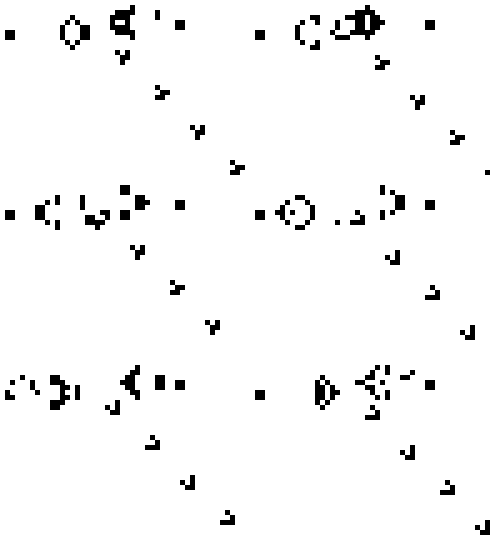
In a defining moment of computational theory, Hungarian-American mathematician John H. Conway introduced the cellular automaton known as the Game of Life. The announcement heralded a new era in the study of complex systems within mathematics and computer science. Conway, whose academic roots trace back to innovations in combinatorial game theory and group theory, sought to explore the emergent behavior of systems from simple, deterministic rules.
The Game of Life operates on an infinite grid of cells that follow a set of four simplistic rules determining whether a cell lives, dies, or reproduces. These rules, despite their simplicity, generate patterns with unexpected and intricate behaviors. Conway's fascination with these emergent complexities stemmed from a broader mathematical interest in how simple systems can lead to unpredictable and complex outcomes.
Once revealed, the Game of Life quickly garnered attention within the academic community and beyond. It served as a compelling metaphor for various scientific phenomena ranging from genetic algorithms to ecological models. Researchers found the game's capacity to simulate lively ecosystem dynamics and self-replication particularly groundbreaking. The cellular automaton attracted extensive programming interest, leading to its implementation in numerous programming environments and contributing significantly to the development of early computer graphics and simulation software.
Additionally, the Game of Life's influence extended to the burgeoning field of theoretical biology, where parallels were drawn to cellular processes and evolutionary theory. Statistical analyses and computer simulations based on the Game of Life shed light on concepts such as natural selection and genetic drift in a controlled yet dynamically evolving environment.
The impact of the Game of Life is underscored by the proliferation of academic papers, software developments, and its status as a foundational topic within introductory courses on complex systems and cellular automata. The influence of this conceptual framework continues to expand within multi-disciplinary research, inspiring investigations into artificial life, network theory, and emergent properties across varied scientific domains.
#GameofLife #CellularAutomaton #ComplexSystems #TheoreticalBiology #ComputationalTheory #JohnHConway #AcademicInnovation #MoofLife
Primary Reference
Timeline of Mathematics | Mathigon

Explore the Life Moments of
 AI Twin