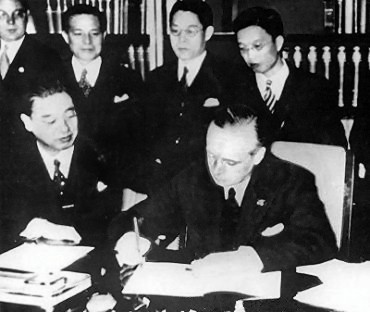
Hungary Joins Anti-Comintern Pact with Germany and Japan
Hungary
Political
Global Trade
5 min read
Updated By: History Editorial Network (HEN)
Published:
Hungary's decision to join the Anti-Comintern Pact with Germany and Japan was a strategic move influenced by geopolitical realities. The Anti-Comintern Pact, initially formed by Germany and Japan, was aimed at opposing the Communist International, often referred to as the Comintern, which was perceived as a significant threat by these nations. The inclusion of Hungary marked the first European country besides Germany to align with this anti-communist bloc.
At the time, Hungary was under the rule of Regent Miklós Horthy and sought to revise the territorial losses imposed by the Treaty of Trianon. Aligning with the Axis powers provided Hungary with potential leverage to reclaim lost territories and counter Soviet influence. The pact bolstered Hungary's international standing among nations with similar political and ideological goals.
From an economic perspective, Hungary was looking to recover from the impacts of the Great Depression and saw cooperation with industrial powers like Germany and Japan as an opportunity for economic stabilization and growth. Additionally, Hungary's military strategy was also influenced by this alliance, as it sought to modernize its armed forces in collaboration with the technologically advanced military infrastructures of Germany and Japan.
The diplomatic move had significant implications for Hungary's foreign policy. By aligning with Germany and Japan, Hungary distanced itself from Western democracies, which viewed the Anti-Comintern Pact with suspicion. It also indicated Hungary's intended commitment to the Axis powers, which would later have profound implications during the broader conflict that engulfed the world.
Statistics show that the Hungarian economy saw a degree of revitalization due to increased trade and military collaboration with Germany. This economic and military cooperation, however, came at the cost of aligning with totalitarian regimes, which would later have grim consequences for the nation.
Hungary's entry into the Anti-Comintern Pact exemplified the intricate interplay of economic necessity, political ambition, and military strategy during a turbulent period in European history. The decision was a pivotal moment that influenced Hungary's course throughout the following decades.
#Hungary #AntiCominternPact #Germany #Japan #Geopolitics #MilitaryStrategy #MoofLife
Primary Reference
Anti-Comintern Pact - Wikipedia

Explore the Life Moments of
 AI Twin