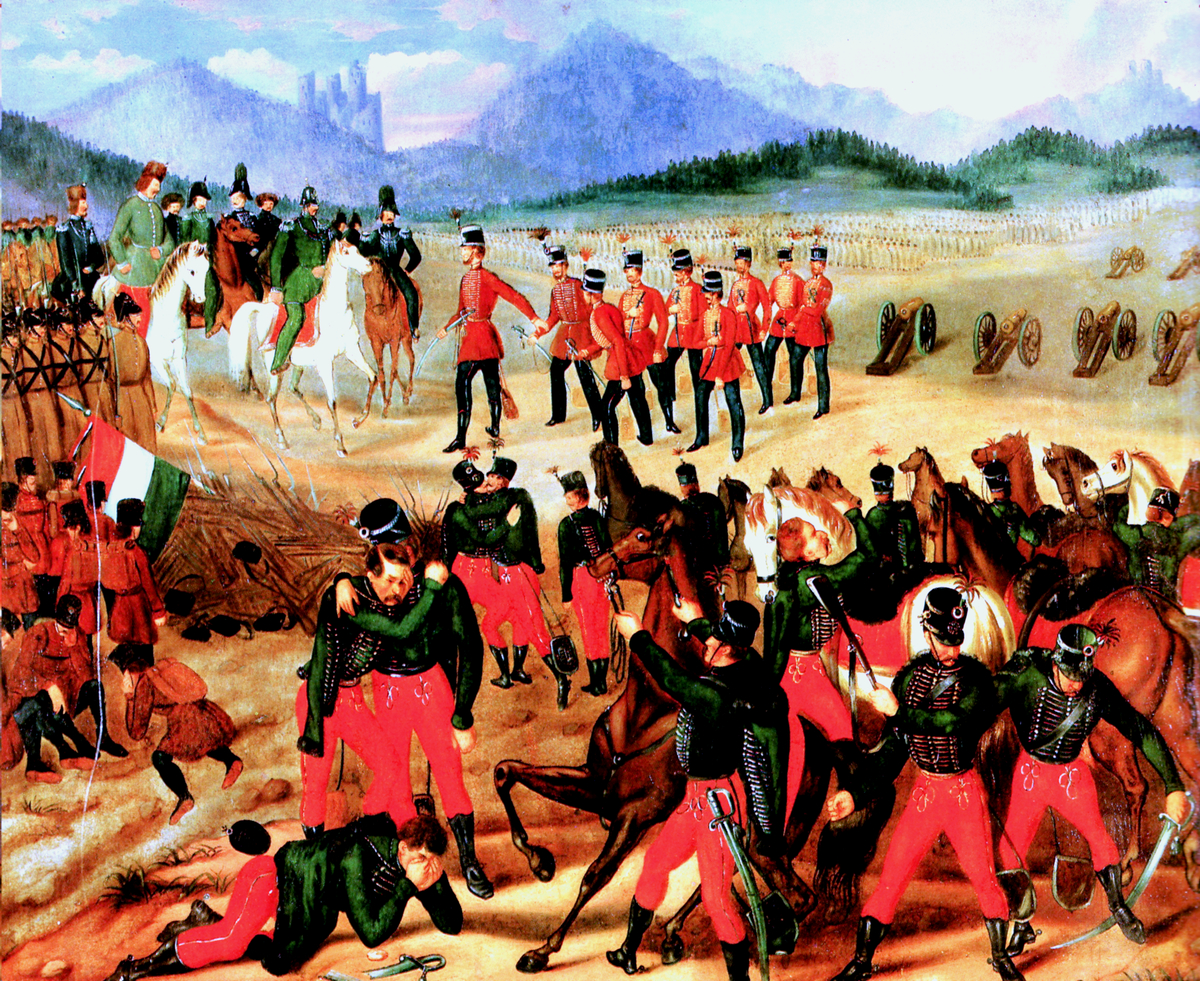
Austrian forces defeat Hungarian Revolution, revolutionaries surrender at Világos.
Hungary
Political
5 min read
Updated By: History Editorial Network (HEN)
Published:
The Hungarian Revolution of 1848-1849 stemmed from a broader wave of revolutions across Europe, driven by demands for national independence and democratic reforms. Among the key actors were Hungarian nationalists who sought autonomy from the Austrian Empire. Their aspiration led to the establishment of a Hungarian government, which enacted significant reforms and declared independence from Habsburg rule.
The Austrian Empire, determined to retain control, assembled a substantial military force. Initially, the Hungarian forces, under the leadership of figures such as Lajos Kossuth and General Artúr Görgei, achieved several victories. However, the tide turned with the intervention of the Russian Empire, which provided military assistance to Austria under the Holy Alliance framework.
The combined Austrian and Russian forces launched a formidable campaign against the Hungarian revolutionaries. The strategic and numerical superiority of the imperial armies gradually eroded the Hungarian resistance. After a protracted series of battles, Hungarian forces faced insurmountable pressure.
The culmination occurred at Világos, where General Görgei, leading the remaining Hungarian troops, was left with grim choices. Recognizing the futility of further resistance and aiming to avert civilian suffering, Görgei opted for surrender. The Hungarian forces laid down their arms in a formal capitulation to the Russian army, marking the decisive end of the revolution in favor of Austrian dominion.
The aftermath saw severe repercussions for Hungary. Austrian reprisals included executions, imprisonments, and enhanced centralized control, stifling Hungarian autonomy efforts. The repression aimed to deter future revolts and consolidate the Habsburg grip on their territories. The events at Világos thus ushered in a period of tightened Austrian oversight over Hungary, imposing significant political and social constraints.
The surrender also symbolized the broader failure of 1848 revolutions in Central Europe, highlighting the resilience of conservative regimes. It underscored the complex geopolitics of the era, where revolutionary fervor often clashed with entrenched imperial interests.
#HungarianRevolution #VilagosSurrender #AustrianEmpire #RevolutionSuppression #EuropeanHistory #MoofLife
Primary Reference
36692_Spielvogel_9e_AP_Upda...

Explore the Life Moments of
 AI Twin