Invasion of Poland sparks WWII conflict.
Germany
Global Conflict
Political
10 min read
Updated By: History Editorial Network (HEN)
Published:
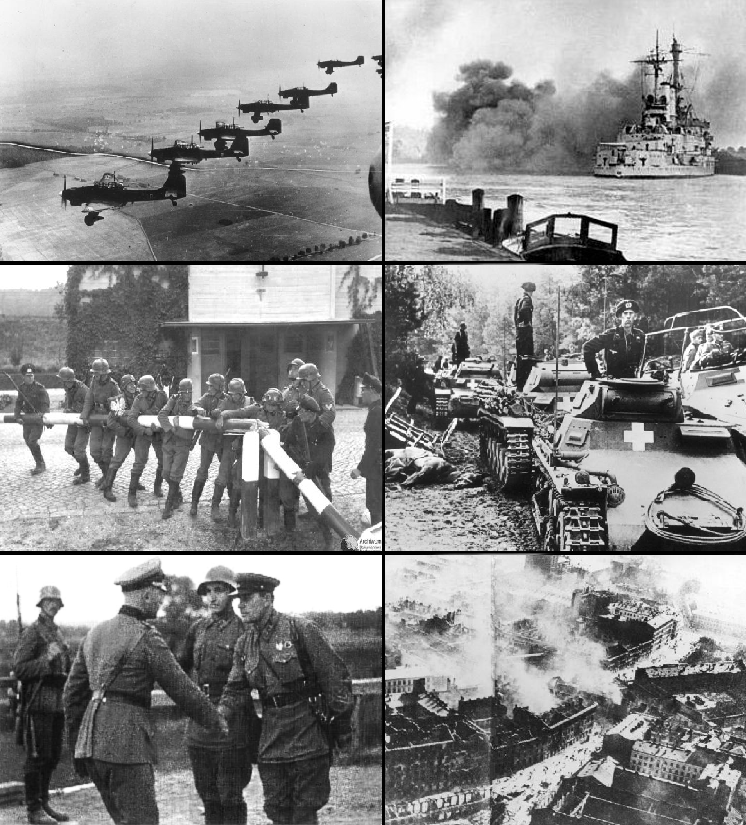
On September 1, 1939, Germany launched its invasion of Poland, a bold and aggressive move that directly sparked the outbreak of World War II. This invasion, orchestrated by Adolf Hitler and executed with unprecedented speed and brutality, marked the beginning of a global conflict that would become the deadliest in human history.
Prelude to War: Germany's Expansionist Ambitions
The roots of the invasion lay in the aggressive expansionist policies of Nazi Germany under Adolf Hitler. Throughout the 1930s, Hitler systematically violated the Treaty of Versailles, which had imposed severe restrictions on Germany after World War I. He rebuilt the German military, remilitarized the Rhineland, and pursued a policy of Lebensraum (living space), aimed at expanding German territory, particularly in Eastern Europe.
Hitler's ambitions were not limited to reclaiming territories lost after World War I. He sought to dominate Europe and, ultimately, the world. His annexation of Austria in 1938 (the Anschluss) and the subsequent occupation of Czechoslovakia demonstrated his intent to expand German control over the continent. These actions, although alarming, were met with limited resistance from other European powers, which sought to avoid another large-scale war through policies of appeasement.
The Molotov-Ribbentrop Pact
A key development leading to the invasion of Poland was the signing of the Molotov-Ribbentrop Pact on August 23, 1939. This non-aggression treaty between Nazi Germany and the Soviet Union stunned the world, as it brought together two ideologically opposed regimes. The pact included a secret protocol that divided Eastern Europe into German and Soviet spheres of influence, with Poland set to be partitioned between the two powers. This agreement gave Hitler the confidence that he could invade Poland without fear of Soviet intervention.
The Invasion: Blitzkrieg Unleashed
At dawn on September 1, 1939, Germany initiated its invasion of Poland with a military strategy that introduced the world to the concept of Blitzkrieg, or "lightning war." This strategy emphasized rapid and coordinated attacks using a combination of infantry, tanks, and airpower to quickly overwhelm the enemy.
The invasion began with aerial bombardments by the Luftwaffe, targeting Polish cities, military installations, and communication networks. This was immediately followed by a ground invasion, with German forces crossing the border from the north, west, and south. The German military, vastly superior in terms of numbers, technology, and organization, quickly overran Polish defenses.
One of the most infamous acts of the invasion was the bombing of the town of Wieluń, which is often regarded as one of the first terror bombings of the war. The destruction of Wieluń and other Polish towns demonstrated the brutal efficiency of Blitzkrieg and set a grim tone for the conflict that would unfold over the next six years.
The International Response: The Outbreak of World War II
Germany’s invasion of Poland prompted an immediate response from Britain and France. Both nations had pledged to defend Polish sovereignty and, on September 3, 1939, they declared war on Germany. However, despite this declaration, neither Britain nor France was able to provide immediate military assistance to Poland, leading to what became known as the "Phoney War," a period of relative inactivity on the Western Front.
The invasion of Poland not only triggered the formal start of World War II but also led to the rapid expansion of the conflict. By the end of 1939, what had started as a regional conflict had grown into a global war, involving nations from Europe, Asia, Africa, and eventually, North and South America.
The Fall of Poland and the German-Soviet Occupation
Despite the valiant efforts of the Polish military, which fought fiercely against the invaders, the combined forces of Germany and, later, the Soviet Union proved overwhelming. On September 17, 1939, the Soviet Union invaded eastern Poland, as agreed upon in the secret protocol of the Molotov-Ribbentrop Pact. This two-front assault led to the rapid collapse of Polish defenses.
By early October, Poland had been completely overrun, and the country was partitioned between Nazi Germany and the Soviet Union. The invasion and subsequent occupation brought untold suffering to the Polish people. Under Nazi rule, Poland became the site of some of the worst atrocities of the Holocaust, as well as widespread persecution, forced labor, and the destruction of its cities and cultural heritage.
#InvasionOfPoland #WorldWarII #Blitzkrieg #NaziGermany #WWIIHistory #Poland1939 #GlobalConflict #MomentsOfLife #MoofLife_Moment #MoofLife
Primary Reference
Invasion of Poland, Fall 1939 | Holocaust Encyclopedia
Explore the Life Moments of
 AI Twin