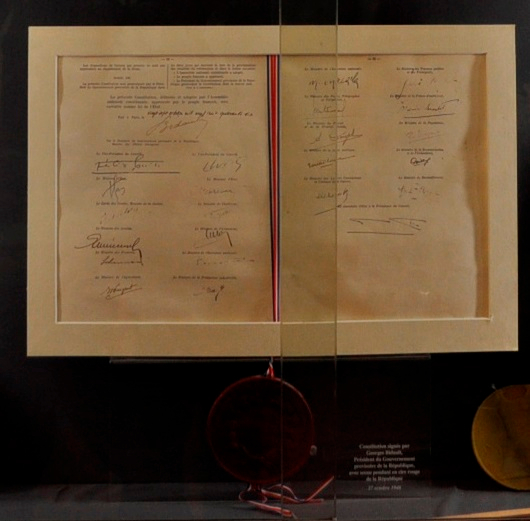
Adoption of the Fourth Republic Constitution
France

Political
3 min read
Updated By: History Editorial Network (HEN)
Published:
Coming out of the aftermath of World War II, France adopted the constitution of the Fourth Republic. This constitution aimed to rebuild the country after the devastation of the war and establish a more stable government system. The Fourth Republic focused on decentralized power, with a strong parliament and a weak executive branch.
The impact of adopting this constitution was significant as it marked a shift in France's political landscape. The new government structure aimed to prevent the concentration of power that had led to the fall of the previous Third Republic. However, the Fourth Republic faced challenges such as economic instability, decolonization struggles, and political unrest.
Despite its efforts to create a more democratic and resilient system, the Fourth Republic's weaknesses became apparent. Internal conflicts and an inability to effectively govern led to its ultimate downfall. In 1958, the Fifth Republic was established, with a more centralized power structure under President Charles de Gaulle.
The adoption of the constitution of the Fourth Republic reflects a pivotal moment in French history as the country sought to rebuild and redefine its political framework post-World War II. #FranceHistory #Constitution #PoliticalEvolution
Primary Reference
The Constitution of 27 October 1946

Explore the Life Moments of
 AI Twin