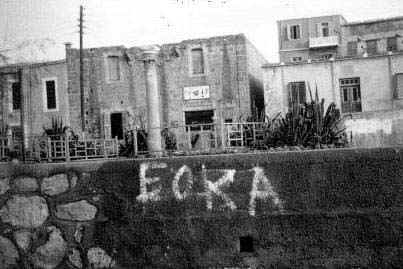
Struggle for Enosis: EOKA's Bomb Attacks
Cyprus
War
10 min read
Updated By: History Editorial Network (HEN)
Published:
Updated:
In April 1955, a series of bomb attacks in Cyprus, orchestrated by the National Organization of Cypriot Fighters (EOKA), marked the beginning of an armed struggle against British colonial rule. EOKA’s ultimate goal was Enosis, the political union of Cyprus with Greece, which had been a long-standing aspiration among Greek Cypriots. This violent campaign initiated a critical and tumultuous phase in the island’s modern history, setting the stage for years of conflict and political upheaval.
The leader of EOKA, Colonel Georgios Grivas, who operated under the pseudonym "Dighenis," spearheaded the insurgency. Grivas, a Cypriot-born Greek nationalist, was deeply committed to the idea of Enosis and believed that only armed resistance could free Cyprus from British control. By this time, the British had governed Cyprus since 1878, and although the island was a British colony, many Greek Cypriots increasingly resented colonial rule and sought unification with Greece. Tensions escalated throughout the early 20th century, especially after World War II, when similar anti-colonial movements were gaining momentum across the world.
On the night of April 1, 1955, EOKA launched coordinated bomb attacks across Cyprus, targeting British military installations, police stations, and key infrastructure in cities like Nicosia, Limassol, and Famagusta. These attacks were intended to signal the start of a broad-based guerrilla campaign aimed at disrupting British authority and gaining international attention for their cause. The sudden outbreak of violence took the British administration by surprise, and over the following months, EOKA escalated its operations, conducting assassinations, sabotage, and ambushes targeting both British officials and Cypriots who opposed Enosis.
In response, the British authorities, under Governor Sir John Harding, declared a state of emergency in Cyprus and embarked on a harsh counter-insurgency campaign. Thousands of Cypriots were arrested, curfews were imposed, and EOKA fighters were hunted relentlessly in the island's rural areas, where they had established hideouts. The British military also recruited Turkish Cypriots into auxiliary police forces, further deepening ethnic divisions on the island, as many Turkish Cypriots feared the prospect of Enosis and sought the continuation of British rule or even partition with Turkey.
The EOKA campaign quickly garnered widespread support among Greek Cypriots, particularly in the rural areas, where grievances against colonial rule were most deeply felt. At the same time, the movement had the backing of Archbishop Makarios III, the political and spiritual leader of the Greek Orthodox Church in Cyprus. Makarios supported the push for Enosis but advocated for a diplomatic approach rather than outright violence. However, his involvement tied the Cypriot Church to the nationalist cause and made him a key figure in the island's political struggle.
The conflict soon became more than just a colonial uprising; it transformed into a complex political and ethnic crisis. Turkish Cypriots, a minority on the island, were largely opposed to Enosis, fearing that union with Greece would marginalize their community. In reaction to the growing violence, many Turkish Cypriots began advocating for Taksim (partition), the division of Cyprus into separate Greek and Turkish zones. As the EOKA insurgency continued, Turkish Cypriot and Greek Cypriot tensions intensified, adding an ethnic dimension to the political conflict.
EOKA's campaign for Enosis lasted until 1959, when the Zurich-London Agreement was signed, bringing an end to the violence and leading to the establishment of an independent Republic of Cyprus in 1960. While Cyprus did not achieve union with Greece, the agreement ensured the island's independence from Britain, albeit with significant provisions for both Greek and Turkish Cypriots, under British, Greek, and Turkish guarantees.
The events of April 1955 and the subsequent EOKA struggle marked a turning point in Cypriot history. The violence and political strife that followed would leave deep scars on the island, with ethnic tensions between Greek and Turkish Cypriots continuing to shape the island's trajectory in the decades to come. Although Enosis was never achieved, the campaign had a profound impact on Cyprus, setting the stage for the complex and unresolved political situation that still defines the island today.
#EOKA #Enosis #CyprusIndependence #GeorgiosGrivas #BritishColonialism #CyprusConflict #ArchbishopMakarios #CyprusHistory #MomentsOfLife #MoofLife_Moment #MoofLife
Primary Reference
On All Fronts: EOKA and the Cyprus Insurgency, 1955-1959
Explore the Life Moments of
 AI Twin