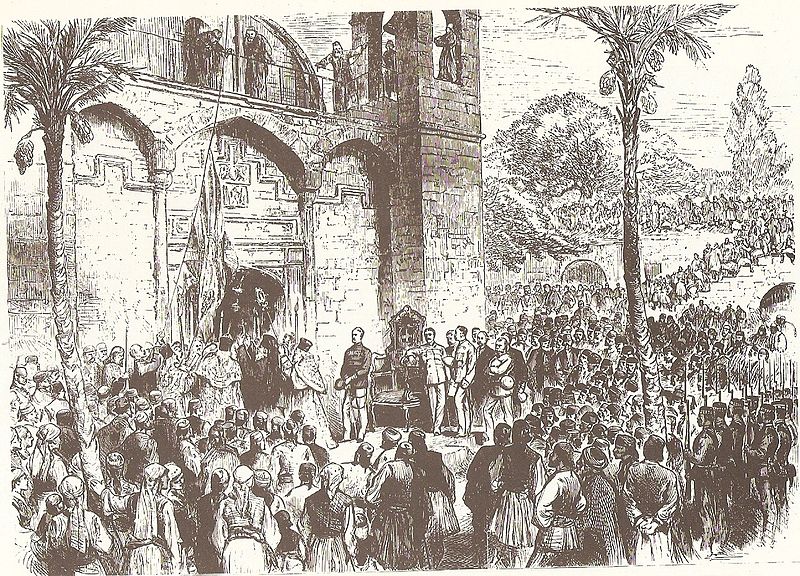
British Occupation Begins Following the Congress of Berlin
Cyprus
Political
Global Trade
5 min read
Updated By: History Editorial Network (HEN)
Published:
Updated:
Following the Congress of Berlin, Cyprus came under British administration with Sir Garnet Joseph Wolseley appointed as the Crown commissioner. This shift was rooted in strategic military and geopolitical considerations. Prior to British control, Cyprus had been under Ottoman rule for over three centuries. The Ottoman Empire, weakened and concerned about growing Russian influence in the Eastern Mediterranean, agreed to lease Cyprus to the British Empire in exchange for military support against Russian expansion.
The British saw Cyprus as a vital asset due to its geographical location, serving as a strategic base in the Mediterranean. This move aimed to strengthen British influence and control in the region, securing routes to India. Sir Garnet Joseph Wolseley, known for his military expertise, was appointed to lead the new administration, reflecting the strategic importance assigned to the island.
Upon arrival, the British faced a landscape marred by underinvestment and neglect. The infrastructure was rudimentary, and the local economy mostly agrarian with limited industrial development. Wolseley and his administration embarked on reforms to optimize the island’s administrative framework and the introduction of English was encouraged alongside Greek and Turkish, the prevalent languages.
The shift impacted the Cypriot socio-political landscape significantly. British law and order systems were implemented, new roads were constructed, and there was a focus on improving public services. Despite these developments, Cypriots' reception to British rule was mixed. While some welcomed the economic opportunities and modernization efforts, many were skeptical and saw the British as new colonial rulers replacing the Ottomans.
Economically, the British taxed the Cypriots heavily to fund administrative costs and pay an annual tribute to the Ottoman Empire, further stirring discontent among locals. Nonetheless, British rule did lay the ground for subsequent developments that would shape modern Cyprus.
The British occupation of Cyprus thus marked a new phase in the island's history, setting the stage for future geopolitical dynamics in the region.
#CyprusHistory #BritishEmpire #ColonialAdministration #Geopolitics #MoofLife #MediterraneanHistory
Primary Reference
History of Cyprus (1878–present) - Wikipedia

Explore the Life Moments of
 AI Twin