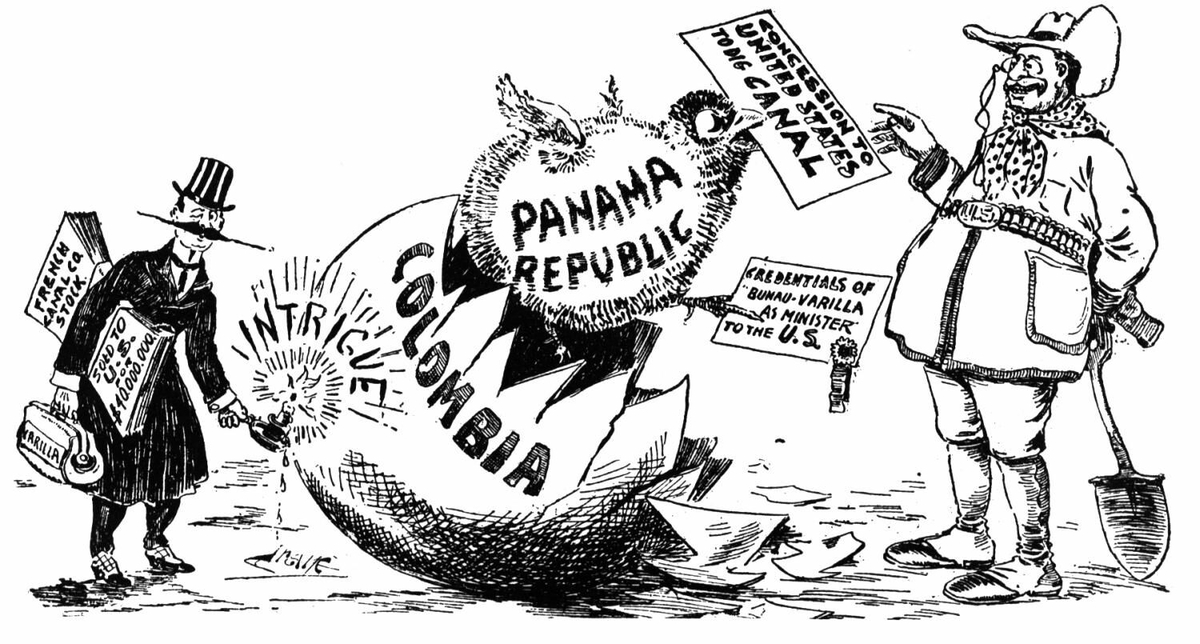
Panama's separation from Colombia with U.S. backing, influencing the construction of the Panama Canal.
Colombia
10 min read
Updated By: History Editorial Network (HEN)
Published:
In 1903, Panama's separation from Colombia was a significant geopolitical event that reshaped the region's landscape and directly influenced the construction of the Panama Canal. This separation, backed by the United States, was driven by strategic and economic interests, particularly the desire to facilitate quicker maritime travel between the Atlantic and Pacific Oceans.
Background
The isthmus of Panama had long been recognized for its strategic importance as a potential site for a canal linking the Atlantic and Pacific Oceans. For centuries, various schemes had been proposed to construct such a canal, but the technological and financial challenges were immense.
In the 19th century, the French attempted to build a canal through Panama under the leadership of Ferdinand de Lesseps, the architect of the Suez Canal. However, due to engineering difficulties, tropical diseases, and financial problems, the French project was abandoned in the 1880s.
U.S. Interest and Colombian Relations
By the early 20th century, the United States had emerged as a global power with significant interest in constructing a canal to enhance its naval capabilities and commercial interests. The U.S. initially negotiated with Colombia, which controlled Panama, to obtain rights to build the canal.
In 1903, the U.S. and Colombia signed the Hay-Herrán Treaty, which granted the U.S. a lease to build the canal. However, the Colombian Senate refused to ratify the treaty, demanding better terms. Frustrated with the negotiations, U.S. President Theodore Roosevelt began to explore alternative means to secure control over the canal zone.
Panama's Independence Movement
Simultaneously, there was growing unrest in Panama, driven by discontent with Colombian rule and the economic potential that a canal project promised. Panamanian separatists saw an opportunity to achieve independence with U.S. support.
On November 3, 1903, Panamanian revolutionaries, with covert backing from the U.S., declared independence from Colombia. The U.S. military presence in the region ensured that the separation occurred with minimal conflict. The presence of the USS Nashville and other U.S. naval vessels effectively prevented Colombian forces from suppressing the revolt.
U.S. Recognition and the Hay-Bunau-Varilla Treaty
The United States quickly recognized the new Republic of Panama and moved to formalize its interests. On November 18, 1903, the U.S. and Panama signed the Hay-Bunau-Varilla Treaty, named after U.S. Secretary of State John Hay and French engineer Philippe Bunau-Varilla, who represented Panama.
The treaty granted the United States control over the Panama Canal Zone, a ten-mile-wide strip of land across the isthmus, in exchange for an initial payment and annual rent to Panama. This agreement allowed the U.S. to commence construction of the canal, a monumental engineering project that would take over a decade to complete.
Construction of the Panama Canal
Construction of the Panama Canal began in earnest under U.S. administration in 1904. Overcoming the challenges that had doomed the French effort, the U.S. project succeeded through the implementation of better engineering techniques and a comprehensive campaign to combat tropical diseases, particularly malaria and yellow fever.
The canal was officially opened on August 15, 1914, revolutionizing global maritime trade by significantly reducing travel time between the Atlantic and Pacific Oceans. The canal quickly became a vital conduit for international shipping, boosting global trade and U.S. strategic interests.
Impact and Legacy
The separation of Panama from Colombia and the subsequent construction of the Panama Canal had profound and lasting impacts:
Geopolitical Influence: The successful completion of the canal solidified U.S. influence in Latin America and established the U.S. as a dominant power in the Western Hemisphere. The Roosevelt Corollary to the Monroe Doctrine was articulated to justify U.S. interventions in Latin American affairs.
Economic Development: The canal facilitated global trade and contributed to the economic development of Panama, though control of the canal by the U.S. was a contentious issue until the Torrijos-Carter Treaties of 1977, which eventually led to Panama gaining control over the canal in 1999.
Engineering Achievement: The construction of the Panama Canal is considered one of the greatest engineering feats of the 20th century, showcasing advances in engineering and medical science.
Colombian-Panamanian Relations: The separation of Panama left a lasting impact on Colombian-Panamanian relations, with Colombia feeling aggrieved by the loss of territory and the manner of U.S. involvement.
#MomentsOfLife #MoofLife_Moment #MoofLife #PanamaCanal #PanamaIndependence #USForeignPolicy #EngineeringMarvel #GeopoliticalShift #1903 #LatinAmericanHistory
Explore the Life Moments of
 AI Twin