Darwin's Theory of Atoll Formation: Pivotal Contribution to Geology and Biology.
United Kingdom
Science
Evolution
4 min read
Updated By: History Editorial Network (HEN)
Published:
Updated:
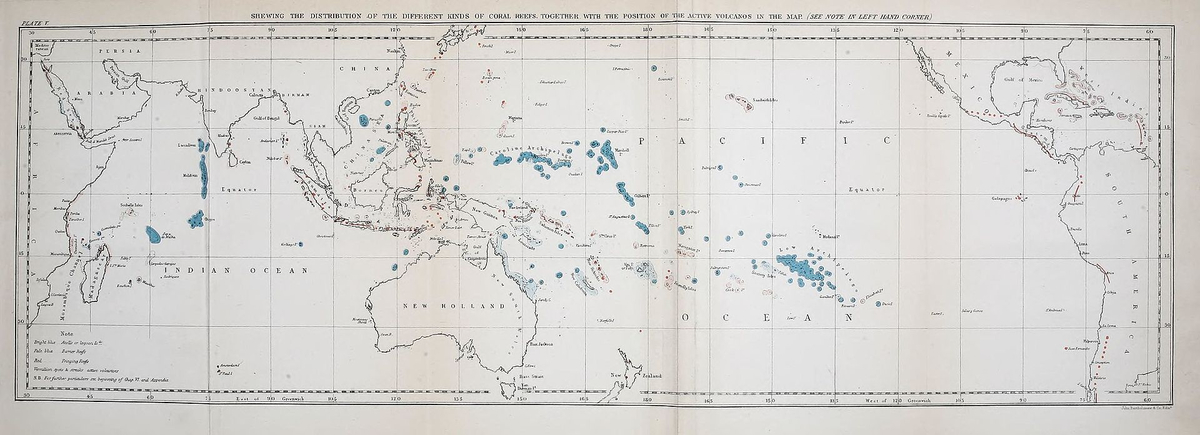
Charles Darwin's publication of "The Structure and Distribution of Coral Reefs" marked a pivotal contribution to the field of geology and biology. In this work, Darwin presented his theory of atoll formation, proposing that these ring-like coral reefs arise from the subsidence of volcanic islands. According to Darwin's observations, reefs begin as fringing reefs surrounding a volcanic island. Over time, as the island subsides, the coral continues to grow upwards, eventually forming a barrier reef with a lagoon between the reef and the remnants of the island. Further subsidence results in the central island disappearing below the water, leaving an atoll—a ring of coral with a central lagoon.
Darwin's theory was based on meticulous observations during his voyage on HMS Beagle. It challenged existing views and provided a consistent explanation for various reef types observed in the oceans. By blending empirical data with careful hypothesis formulation, Darwin's work laid a foundation for future research in marine biology and geology. His theory of atoll formation was initially met with skepticism but eventually gained acceptance and remains influential.
This publication not only advanced scientific understanding of coral reefs, but also demonstrated Darwin's methodical approach to research, combining field observations with theoretical insights. It was significant in highlighting the dynamic and ever-changing nature of Earth's geological processes. The accurate description and logical reasoning in his work provided a template for future scientific research methodologies.
#Darwin #CoralReefs #AtollFormation #MarineBiology #Geology #ScienceHistory #MoofLife
Explore the Life Moments of
 AI Twin