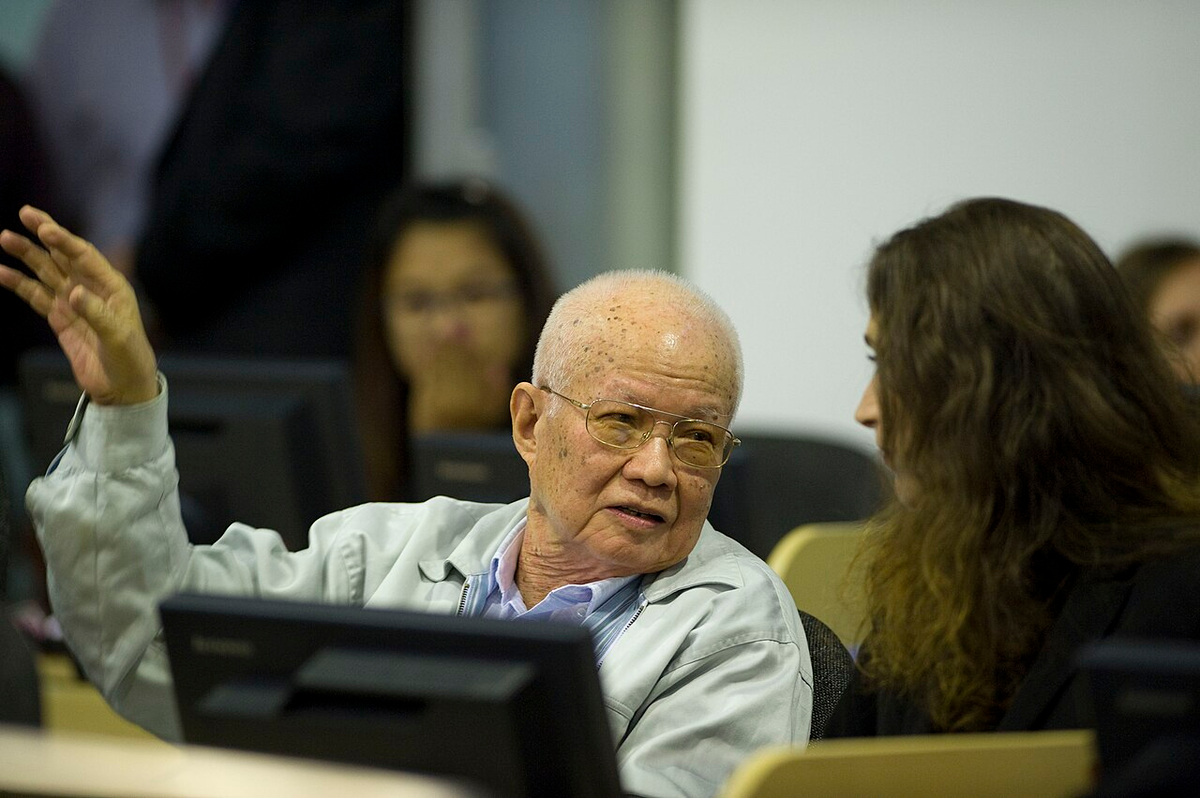
Most senior surviving Khmer Rouge member, Nuon Chea - "Brother Number Two" - is arrested and charged with crimes against humanity.
Cambodia
9 min read
Updated By: History Editorial Network (HEN)
Published:
In 2007, a significant event unfolded in Cambodia's quest for justice for the atrocities committed during the Khmer Rouge regime: the arrest of Nuon Chea, also known as "Brother Number Two." As the most senior surviving leader of the Khmer Rouge, his capture marked a pivotal moment in the efforts to hold the regime's top officials accountable for crimes against humanity.
Background of Nuon Chea
Nuon Chea was born in 1926 in Battambang Province, Cambodia. He was educated in Thailand and later in the Netherlands, where he was exposed to Marxist ideologies. Upon his return to Cambodia, he became deeply involved in the communist movement and was a founding member of the Communist Party of Kampuchea (CPK), which later became known as the Khmer Rouge.
Nuon Chea rose to prominence within the party, serving as its chief ideologue and the second-in-command to Pol Pot, the regime's infamous leader. As "Brother Number Two," he was instrumental in shaping the party's policies and strategies, which led to one of the most devastating genocides of the 20th century.
The Khmer Rouge Regime
From 1975 to 1979, the Khmer Rouge ruled Cambodia with an iron fist, implementing radical agrarian policies that aimed to create a classless, communist society. This brutal social engineering experiment resulted in the deaths of an estimated 1.7 million people—nearly a quarter of Cambodia's population—due to starvation, forced labor, torture, and mass executions.
Nuon Chea played a central role in the regime's repressive measures. He was responsible for overseeing the security apparatus, which included the notorious S-21 prison, where thousands of perceived enemies of the state were tortured and executed. His ideological zeal and unwavering commitment to the party's radical vision contributed significantly to the scale and severity of the atrocities.
Arrest and Charges
After the fall of the Khmer Rouge in 1979, Nuon Chea retreated to the remote jungle regions near the Thai border, where he continued to resist the new Cambodian government. It wasn't until 1998, after the surrender of remaining Khmer Rouge forces, that he finally laid down his arms and ostensibly retired from public life.
However, the wheels of justice continued to turn. In 2006, the Extraordinary Chambers in the Courts of Cambodia (ECCC) was established to prosecute senior leaders of the Khmer Rouge for crimes committed during their rule. On September 19, 2007, Nuon Chea was arrested at his home in Pailin and brought to Phnom Penh to face charges.
He was charged with crimes against humanity, genocide, and war crimes. His arrest was a momentous occasion for the Cambodian people, many of whom had suffered under the brutal regime and had long awaited justice. The charges against him included responsibility for the deaths and suffering of millions, overseeing mass executions, forced labor, and other inhumane acts.
The Trial and Its Significance
Nuon Chea's trial began in 2011 as part of Case 002 at the ECCC. He was tried alongside other senior leaders, including Khieu Samphan, the former head of state, and Ieng Sary, the former foreign minister. The trial was a landmark in international justice, as it sought to address the extensive crimes committed by the Khmer Rouge.
During the proceedings, Nuon Chea maintained his innocence, often blaming Vietnamese forces and lower-ranking officials for the atrocities. Despite his denials, the court presented overwhelming evidence of his culpability, including testimonies from survivors and documentation of his direct involvement in the regime's brutal policies.
Verdict and Legacy
In August 2014, Nuon Chea was found guilty of crimes against humanity and sentenced to life imprisonment. This verdict was later upheld in November 2018, reaffirming his responsibility for the horrific acts committed under the Khmer Rouge. The conviction of Nuon Chea was a significant achievement for the ECCC and a crucial step towards justice for the victims and their families.
Nuon Chea's arrest and subsequent trial underscored the importance of accountability and the rule of law in addressing the legacy of genocide and mass atrocities. It demonstrated that, despite the passage of time, efforts to seek justice for crimes against humanity must persist.
#MomentsOfLife #MoofLife_Moment #MoofLife #KhmerRouge #CambodianHistory #JusticeServed #GenocideTribunals
Explore the Life Moments of
 AI Twin