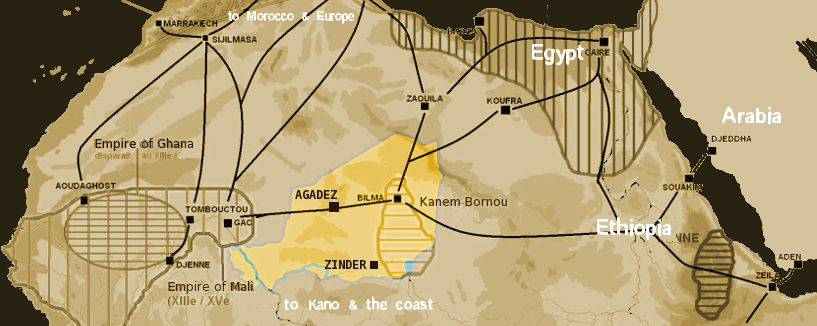
Trade Expansion along Trans-Saharan Routes in the Region
Burkina Faso

Global Trade
Economic Expansion
3 min read
Updated By: History Editorial Network (HEN)
Published:
In 1200, the expansion of trade along the Trans-Saharan routes in the region now known as Burkina Faso, marked a pivotal moment in the economic landscape of West Africa. This development was driven by the increasing demand for goods such as gold, salt, ivory, and slaves, prompting the emergence of vibrant commercial centers and caravan routes.
With the introduction of camels to the region, trade routes were able to extend further into the Sahara Desert, connecting the savannah regions in the south to the markets of North Africa and beyond. This facilitated the exchange of goods and ideas between diverse cultures, fostering economic growth and cultural exchange.
The expansion of trade along the Trans-Saharan routes had a profound impact on the societies of West Africa, leading to the rise of powerful trading states and the establishment of long-lasting economic networks. It also contributed to the spread of Islam in the region, as merchants and travelers brought new religious beliefs along with their trade goods.
This event highlights the importance of trade as a catalyst for cultural exchange, economic development, and connectivity between distant regions. #TransSaharanTrade #EconomicExpansion #CulturalExchange #WestAfrica #BurkinaFaso
Primary Reference
The Spread of Islam in West Africa: Containment, Mixing, and ...

Explore the Life Moments of
 AI Twin