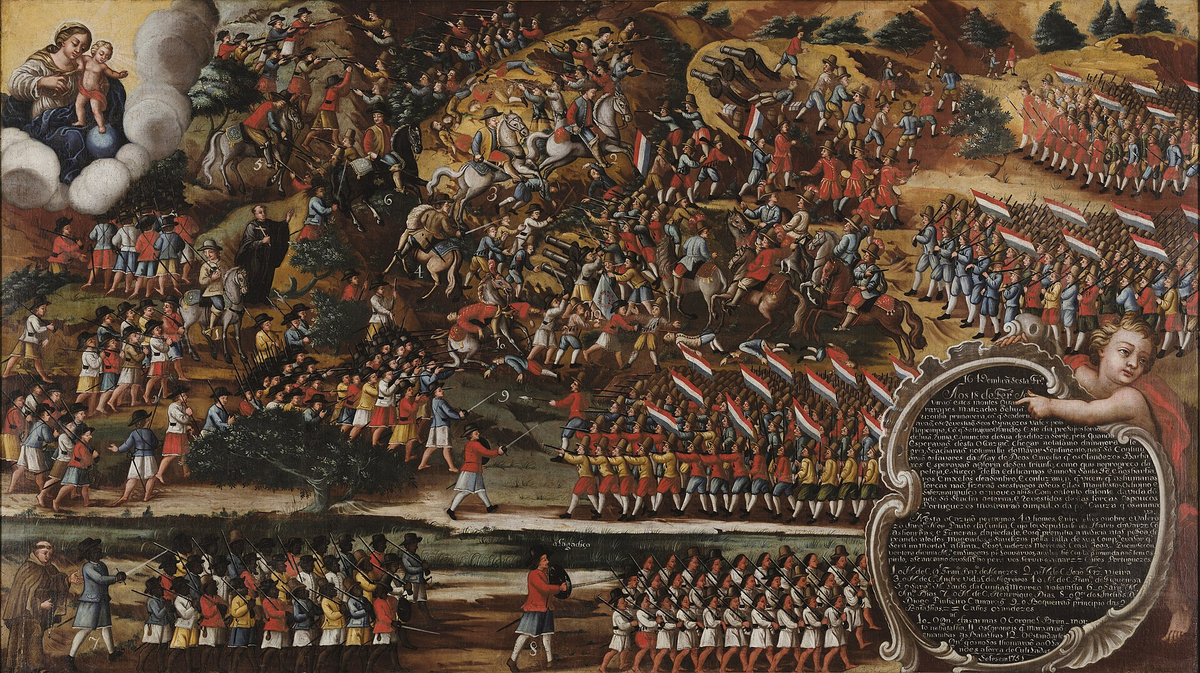
Second Battle of Guararapes: decisive Portuguese victory against the Dutch in northeast Brazil
Brazil
9 min read
Updated By: History Editorial Network (HEN)
Published:
The Second Battle of Guararapes, fought on February 19, 1649, stands as a pivotal event in Brazilian history, marking a decisive Portuguese victory against the Dutch forces in northeast Brazil. This battle was a crucial part of the conflict known as the Dutch-Portuguese War, which spanned several decades as the two European powers vied for control over lucrative colonial territories in the Americas, Africa, and Asia.
Background
In the early 17th century, the Dutch, through the Dutch West India Company, sought to expand their colonial empire and capture Portuguese-held territories in Brazil. They succeeded in occupying key areas in the northeast, including the prosperous sugar-producing region of Pernambuco. The Dutch established a stronghold in Recife, turning it into a thriving commercial hub under the leadership of John Maurice of Nassau.
However, the Portuguese, supported by local Brazilian settlers and indigenous allies, launched a resistance movement to reclaim their territories. The First Battle of Guararapes, fought in 1648, was a significant turning point, where a coalition of Portuguese forces, Brazilian colonists, and native warriors defeated the Dutch, setting the stage for the second confrontation.
The Battle
The Second Battle of Guararapes took place near the Guararapes Hills in Pernambuco. The Portuguese and their allies, numbering around 2,200 men, faced a well-equipped Dutch force of about 4,500 soldiers. Despite being outnumbered, the Portuguese leveraged their superior knowledge of the local terrain and adopted guerrilla warfare tactics, which proved highly effective in the dense, hilly landscape.
The Portuguese forces were commanded by Francisco Barreto de Meneses and João Fernandes Vieira, two experienced military leaders who orchestrated a coordinated and strategic assault on the Dutch. Their troops, composed of a diverse mix of Portuguese soldiers, Afro-Brazilian slaves, indigenous warriors, and local militias, demonstrated remarkable resilience and unity.
The Dutch, led by the experienced General Sigismund van Schoppe, attempted to maintain their positions and counter the Portuguese attacks. However, they struggled with the challenging terrain and the unconventional warfare tactics employed by their adversaries. The Portuguese forces capitalized on their familiarity with the environment, launching surprise attacks and ambushes that decimated the Dutch ranks.
Outcome
The battle culminated in a resounding victory for the Portuguese and their allies. The Dutch forces were routed, suffering heavy casualties, with many soldiers killed, wounded, or taken prisoner. The Portuguese victory at the Second Battle of Guararapes effectively crippled Dutch military power in the region and marked the beginning of the end of Dutch ambitions in Brazil.
Following this defeat, the Dutch struggled to maintain their foothold in northeast Brazil. Over the next few years, continued Portuguese resistance and strategic offensives led to the eventual withdrawal of Dutch forces from Brazil. By 1654, the Portuguese had successfully reclaimed all previously occupied territories, solidifying their control over Brazil.
Significance
The Second Battle of Guararapes is celebrated as a defining moment in Brazilian history. It symbolized the strength and resilience of the Brazilian people and their ability to unite across ethnic and social lines to defend their land against foreign invaders. The battle is often regarded as a precursor to Brazilian nationalism and the eventual emergence of Brazil as an independent nation.
The victory also had significant implications for the colonial balance of power in South America. It marked the decline of Dutch influence and the reaffirmation of Portuguese dominance in the region, which would persist until Brazil's independence in the early 19th century.
Legacy
Today, the Battle of Guararapes is commemorated as a symbol of national unity and resistance. The site of the battle is preserved as a historical monument, and the event is remembered through various cultural and military ceremonies. The Brazilian Army honors the battle as the origin of its military traditions, celebrating the bravery and strategic acumen of the forces that fought for the country's sovereignty.
#SecondBattleOfGuararapes #PortugueseVictory #DutchPortugueseWar #BrazilianHistory #ColonialBrazil #GuararapesHills #NationalUnity #MomentsOfLife #MoofLife_Moment #MoofLife

Explore the Life Moments of
 AI Twin