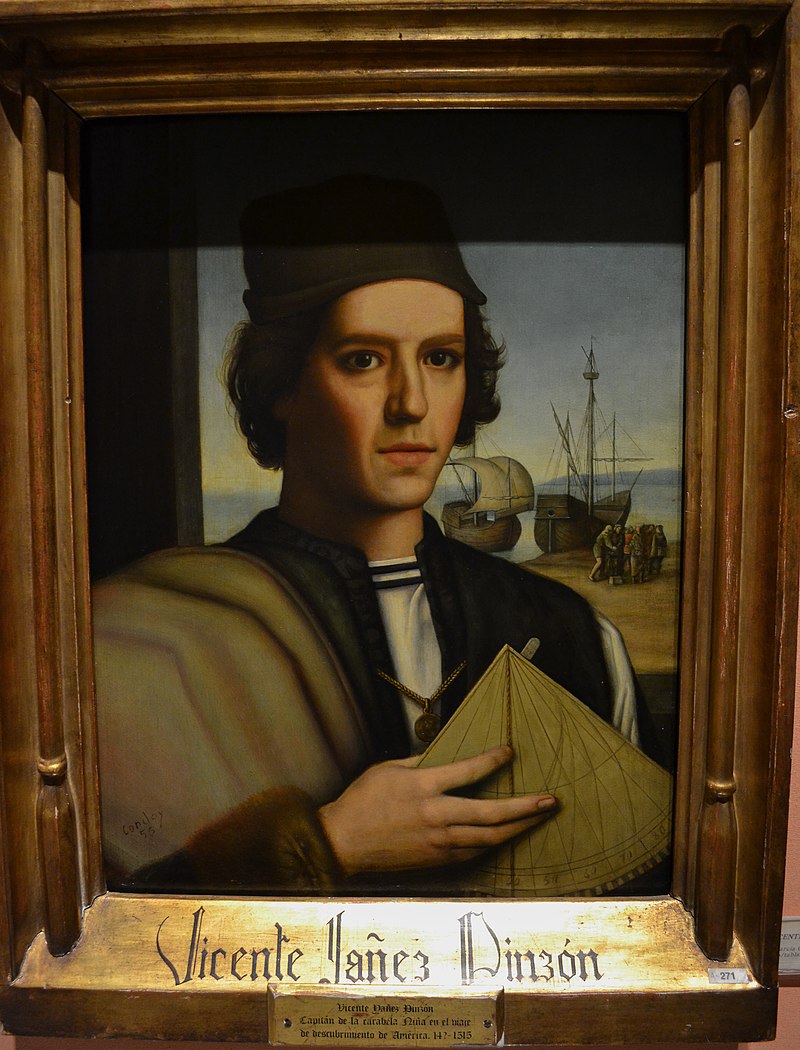
Earliest European Landing in Brazil predated Cabral's arrival by Vicente Yañez Pinzón
Cabo de Santo Agostinho (Pernambuco), Brazil
'/%3e%3cpath id='l' d='M-26.25 0h52.5v-12h-40.5v-16h33v-12h-33v-11H25v-12h-51.25z'/%3e%3cpath id='k' d='M-31.5 0h12v-48l14 48h11l14-48V0h12v-70H14L0-22l-14-48h-17.5z'/%3e%3cpath id='b' fill-rule='evenodd' d='M0 0a31.5 35 0 0 0 0-70A31.5 35 0 0 0 0 0m0-13a18.5 22 0 0 0 0-44 18.5 22 0 0 0 0 44'/%3e%3cpath id='d' fill-rule='evenodd' d='M-31.5 0h13v-26h28a22 22 0 0 0 0-44h-40zm13-39h27a9 9 0 0 0 0-18h-27z'/%3e%3cpath id='n' d='M-15.75-22C-15.75-15-9-11.5 1-11.5s14.74-3.25 14.75-7.75c0-14.25-46.75-5.25-46.5-30.25C-30.5-71-6-70 3-70s26 4 25.75 21.25H13.5c0-7.5-7-10.25-15-10.25-7.75 0-13.25 1.25-13.25 8.5-.25 11.75 46.25 4 46.25 28.75C31.5-3.5 13.5 0 0 0c-11.5 0-31.55-4.5-31.5-22z'/%3e%3cuse xlink:href='%23a' id='o' transform='scale(31.5)'/%3e%3cuse xlink:href='%23a' id='p' transform='scale(26.25)'/%3e%3cuse xlink:href='%23a' id='r' transform='scale(21)'/%3e%3cuse xlink:href='%23a' id='q' transform='scale(15)'/%3e%3cuse xlink:href='%23a' id='s' transform='scale(10.5)'/%3e%3cg id='m'%3e%3cclipPath id='c'%3e%3cpath d='M-31.5 0v-70h63V0zM0-47v12h31.5v-12z'/%3e%3c/clipPath%3e%3cuse xlink:href='%23b' clip-path='url(%23c)'/%3e%3cpath d='M5-35h26.5v10H5z'/%3e%3cpath d='M21.5-35h10V0h-10z'/%3e%3c/g%3e%3cg id='h'%3e%3cuse xlink:href='%23d'/%3e%3cpath d='M28 0c0-10 0-32-15-32H-6c22 0 22 22 22 32'/%3e%3c/g%3e%3cg id='a' fill='%23fff'%3e%3cg id='f'%3e%3cpath id='e' d='M0-1v1h.5' transform='rotate(18 0 -1)'/%3e%3cuse xlink:href='%23e' transform='scale(-1 1)'/%3e%3c/g%3e%3cuse xlink:href='%23f' transform='rotate(72)'/%3e%3cuse xlink:href='%23f' transform='rotate(-72)'/%3e%3cuse xlink:href='%23f' transform='rotate(144)'/%3e%3cuse xlink:href='%23f' transform='rotate(216)'/%3e%3c/g%3e%3c/defs%3e%3crect width='100%25' height='100%25' x='-50%25' y='-50%25' fill='%23009b3a'/%3e%3cpath fill='%23fedf00' d='M-1743 0 0 1113 1743 0 0-1113z'/%3e%3ccircle r='735' fill='%23002776'/%3e%3cclipPath id='g'%3e%3ccircle r='735'/%3e%3c/clipPath%3e%3cpath fill='%23fff' d='M-2205 1470a1785 1785 0 0 1 3570 0h-105a1680 1680 0 1 0-3360 0z' clip-path='url(%23g)'/%3e%3cg fill='%23009b3a' transform='translate(-420 1470)'%3e%3cuse xlink:href='%23b' y='-1697.5' transform='rotate(-7)'/%3e%3cuse xlink:href='%23h' y='-1697.5' transform='rotate(-4)'/%3e%3cuse xlink:href='%23i' y='-1697.5' transform='rotate(-1)'/%3e%3cuse xlink:href='%23j' y='-1697.5' transform='rotate(2)'/%3e%3cuse xlink:href='%23k' y='-1697.5' transform='rotate(5)'/%3e%3cuse xlink:href='%23l' y='-1697.5' transform='rotate(9.75)'/%3e%3cuse xlink:href='%23d' y='-1697.5' transform='rotate(14.5)'/%3e%3cuse xlink:href='%23h' y='-1697.5' transform='rotate(17.5)'/%3e%3cuse xlink:href='%23b' y='-1697.5' transform='rotate(20.5)'/%3e%3cuse xlink:href='%23m' y='-1697.5' transform='rotate(23.5)'/%3e%3cuse xlink:href='%23h' y='-1697.5' transform='rotate(26.5)'/%3e%3cuse xlink:href='%23j' y='-1697.5' transform='rotate(29.5)'/%3e%3cuse xlink:href='%23n' y='-1697.5' transform='rotate(32.5)'/%3e%3cuse xlink:href='%23n' y='-1697.5' transform='rotate(35.5)'/%3e%3cuse xlink:href='%23b' y='-1697.5' transform='rotate(38.5)'/%3e%3c/g%3e%3cuse xlink:href='%23o' x='-600' y='-132'/%3e%3cuse xlink:href='%23o' x='-535' y='177'/%3e%3cuse xlink:href='%23p' x='-625' y='243'/%3e%3cuse xlink:href='%23q' x='-463' y='132'/%3e%3cuse xlink:href='%23p' x='-382' y='250'/%3e%3cuse xlink:href='%23r' x='-404' y='323'/%3e%3cuse xlink:href='%23o' x='228' y='-228'/%3e%3cuse xlink:href='%23o' x='515' y='258'/%3e%3cuse xlink:href='%23r' x='617' y='265'/%3e%3cuse xlink:href='%23p' x='545' y='323'/%3e%3cuse xlink:href='%23p' x='368' y='477'/%3e%3cuse xlink:href='%23r' x='367' y='551'/%3e%3cuse xlink:href='%23r' x='441' y='419'/%3e%3cuse xlink:href='%23p' x='500' y='382'/%3e%3cuse xlink:href='%23r' x='365' y='405'/%3e%3cuse xlink:href='%23p' x='-280' y='30'/%3e%3cuse xlink:href='%23r' x='200' y='-37'/%3e%3cuse xlink:href='%23o' y='330'/%3e%3cuse xlink:href='%23p' x='85' y='184'/%3e%3cuse xlink:href='%23p' y='118'/%3e%3cuse xlink:href='%23r' x='-74' y='184'/%3e%3cuse xlink:href='%23q' x='-37' y='235'/%3e%3cuse xlink:href='%23p' x='220' y='495'/%3e%3cuse xlink:href='%23r' x='283' y='430'/%3e%3cuse xlink:href='%23r' x='162' y='412'/%3e%3cuse xlink:href='%23o' x='-295' y='390'/%3e%3cuse xlink:href='%23s' y='575'/%3e%3c/svg%3e)
Brazilian European Exploration
9 min read
Updated By: History Editorial Network (HEN)
Published:
Updated:
On 26 January 1500, Spanish navigator Vicente Yáñez Pinzón made the earliest documented European landfall in Brazil at Cabo de Santo Agostinho (Pernambuco)-months before Pedro Álvares Cabral arrived.
In January 1500, Vicente Yañez Pinzón led the first recorded European landing in Brazil, preceding Cabral's arrival. Pinzón, a Spanish navigator, ventured ashore near modern-day Recife. This historic moment marked Europe's initial contact with Brazil's indigenous people and landscapes. The encounter paved the way for future European explorations and colonization efforts in the region.
Pinzón's landing had far-reaching implications, shaping the course of Brazilian history. It opened the door to centuries of Portuguese colonization and the establishment of a new cultural and economic order in the region. The arrival of Pinzón also set in motion the transatlantic slave trade, profoundly impacting the lives of countless Africans and indigenous peoples.
This milestone in Brazilian history underscores the complex interplay of exploration, colonization, and exploitation that defined the early interactions between Europeans and native populations in the Americas. Pinzón's expedition laid the groundwork for the cultural, social, and political dynamics that continue to shape Brazil to this day.
On 26-Jan-1500, Spanish navigator Vicente Yáñez Pinzón reached the coast of present-day Brazil, making what many accounts describe as the earliest recorded European landfall on Brazilian territory - months before Pedro Álvares Cabral’s Portuguese arrival in April 1500.
Location (landfall/anchorage): the cape Pinzón named Cabo de Santa María de la Consolación, generally associated with the Cabo de Santo Agostinho / Suape area (Pernambuco, near modern Recife), Brazil.
Pinzón’s 1500 landfall happened in the intense early phase of Iberian Atlantic exploration that followed Columbus’s first voyage. After previously sailing with Columbus (he had captained the Niña), Pinzón launched his own expedition from Palos, Spain, and by late January he sighted a prominent stretch of the Brazilian coastline. He gave the headland a devotional name-Santa María de la Consolación-and the fleet anchored at a protected spot suitable for small boats, widely linked to the Suape anchorage along Pernambuco’s coast.
The moment is historically significant not only for the date, but for what followed. Pinzón continued exploring along the northern coast, reaching the Amazon River estuary, where the dramatic freshwater outflow was so striking that he associated it with a “sweetwater sea” (Mar Dulce) and used the currents to continue his route before returning toward the Caribbean and then back to Spain. These observations became part of the early European geographic understanding of South America’s Atlantic shore and its immense river systems.
Why didn’t Spain secure Brazil after such an early arrival? The politics of empire mattered as much as seamanship. Under the Treaty of Tordesillas (1494)-an agreement dividing overseas spheres of influence between Spain and Portugal-the eastern “bulge” of South America fell into Portugal’s zone. As a result, Pinzón could not easily convert a brief landfall into an uncontested Spanish territorial claim, and Portugal’s later expedition under Cabral formally asserted possession for the Portuguese Crown.
Historians also note uncertainties typical of this period (routes, exact landfall points, and later retellings), and some discussions compare Pinzón’s account with Cabral’s better-documented Portuguese claim. Even so, 26-Jan-1500 remains a widely cited date for Pinzón’s Brazilian coast sighting/landing and a key “pre-Cabral” milestone in the European encounter with Brazil.
Pinzón’s 26 January 1500 landfall is most commonly placed at the cape he named “Santa María de la Consolación,” generally identified with Cabo de Santo Agostinho (Pernambuco, northeastern Brazil)-near modern Recife-with many accounts linking his anchorage to the Suape area (a sheltered port/cove on that coast).
Note: some historians caution that the exact modern identification is debated, but the Pernambuco / Cape-of-Consolation–Cabo de Santo Agostinho identification is the most frequently cited.
#BrazilianHistory #EuropeanExploration #ColonizationEra #CulturalEncounters
#VicenteYáñezPinzón
Primary Reference
Pinzón becomes first European to land in Brazil

Explore the Life Moments of
 AI Twin