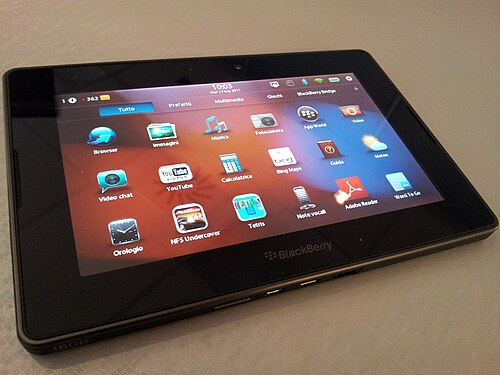
BlackBerry PlayBook tablet officially launched.
United States
5 min read
Updated By: History Editorial Network (HEN)
Published:
Research In Motion (RIM), the company behind the BlackBerry brand, officially launched the BlackBerry PlayBook tablet on 19/04/2011 in the United States and Canada. The tablet represented BlackBerry’s entry into the rapidly growing tablet computer market that had expanded following the introduction of Apple’s iPad in 2010.
The BlackBerry PlayBook featured a 7-inch touchscreen display, a dual-core 1 GHz processor, and the BlackBerry Tablet OS based on QNX software technology, which RIM had acquired through its purchase of QNX Software Systems in 2010. The device supported multitasking, Adobe Flash, HD video playback, and front and rear cameras, positioning it as a business-oriented multimedia tablet. Initial models were released with storage options of 16 GB, 32 GB, and 64 GB.
One of the PlayBook’s central features was its integration with BlackBerry smartphones through a system called BlackBerry Bridge. This allowed users to access email, calendars, and enterprise data from a connected BlackBerry phone while maintaining RIM’s focus on secure communication. At launch, however, the tablet did not include native email, calendar, or contacts applications unless paired with a BlackBerry smartphone, a limitation that received significant criticism from reviewers and consumers.
The PlayBook launch occurred during increasing competition in the mobile technology sector as companies including Apple, Samsung, Motorola, and Hewlett-Packard expanded their tablet offerings. RIM promoted the PlayBook as a professional-grade device with strong multitasking and enterprise security capabilities, but the product struggled to achieve major commercial success. In later years, RIM introduced software updates adding standalone email and application support, though sales remained below expectations.
The PlayBook became part of a broader transitional period for RIM as the company attempted to compete against iOS and Android ecosystems while preparing its next-generation BlackBerry 10 operating system. Production of consumer PlayBook tablets was eventually discontinued after several years of declining market performance.
#BlackBerry #PlayBook #RIM #TabletComputer #MobileTechnology #TechHistory
Primary Reference
BlackBerry_Limited

Explore the Life Moments of
 AI Twin