Evel Knievel
Entertainment
4 min read
Updated By: History Editorial Network (HEN)
Published:
Updated:
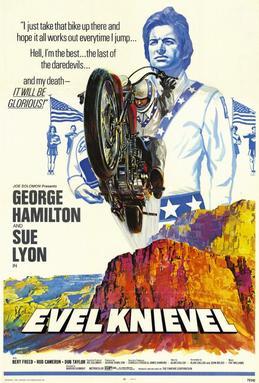
Evel Knievel (1971) is a fast-paced, myth-building biographical drama directed by Marvin J. Chomsky, chronicling the rise of America’s most daring and iconic stuntman, Evel Knievel. George Hamilton stars in the title role and also produced the film, portraying Knievel as a larger-than-life figure whose mix of reckless bravado, showmanship, and ego made him a national sensation. Structured as a fictionalized memoir told in flashback just before a major stunt, the film traces Knievel’s early days as a rebellious kid in Butte, Montana, his battles with authority, his love for wife Linda, and his path to fame through increasingly dangerous motorcycle jumps.
The tone leans more toward hagiography than gritty realism, framing Knievel as a uniquely American hero—part outlaw, part patriot—who taunts death with every leap but maintains a moral compass and a love for country. While the film glosses over many of Knievel’s more controversial traits, it captures the spectacle and obsession with danger that defined his public persona.
Upon release, Evel Knievel received mixed critical reviews but gained attention for its stunts, patriotic tone, and Hamilton’s earnest performance. It did modest business at the box office but helped solidify Knievel’s cultural status at a time when his real-life jumps were captivating TV audiences. The film’s stylized approach and mythic framing paved the way for Knievel’s continued presence in pop culture, including later documentaries and dramatizations.
Today, Evel Knievel is remembered as a flashy, slightly sanitized but entertaining time capsule that captures the daredevil era of 1970s Americana and the legend of a man who turned pain, risk, and spectacle into a national obsession.
Primary Reference
Interview with George Hamilton at Pop Entertainment

Explore the Life Moments of
 AI Twin