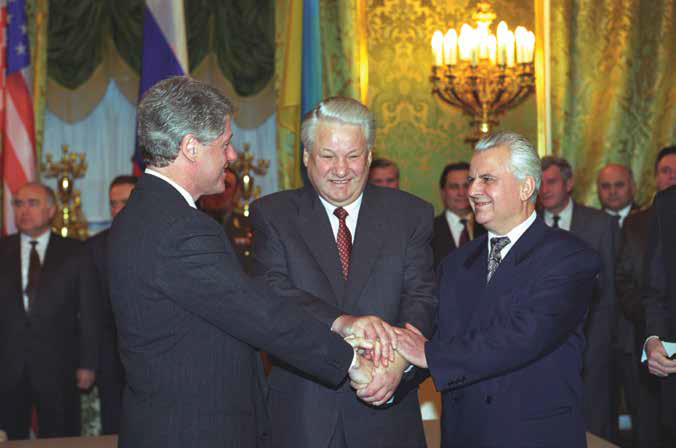
Nuclear missile accord signed by US and Russia.
United States of America

Political
Global Trade
5 min read
Updated By: History Editorial Network (HEN)
Published:
In an event marking a pivotal point in global diplomacy and security, U.S. President Bill Clinton and Russian President Boris Yeltsin signed the Kremlin Accords. This critical agreement curtailed decades of Cold War-era tensions by mutually agreeing to stop targeting nuclear missiles at each other's countries, reducing the threat of a sudden nuclear confrontation.
The background of this agreement can be traced to the dissolution of the Soviet Union and the subsequent end to the Cold War, a period characterized by intense rivalry and the constant threat of nuclear war. With the collapse of the Soviet Union, Russia emerged as the primary successor state, inheriting both international responsibilities and an extensive nuclear arsenal.
Efforts leading to the Kremlin Accords included multiple rounds of negotiations and the establishment of trust-building measures between the two states. High on the agenda was the need to cement peace and stability in the post-Cold War era. Mutual missile de-targeting formed a tangible step towards reducing the reliance on nuclear arsenals and legitimizing cooperative action in ensuring global security.
The impact of the Kremlin Accords was immediate and far-reaching. It symbolized a strategic de-escalation and a move towards more normalized U.S.-Russia relations. The agreement explicitly reflected both nations' commitment to decrease the likelihood of accidental or intentional nuclear exchanges. This measure significantly alleviated global fears over nuclear annihilation, promoting a sense of safety on the international stage.
Statistically, the agreed upon action led to the de-targeting of thousands of nuclear warheads in both countries, playing a crucial role in various subsequent arms reduction treaties. It further established a framework for dialogues and initiatives aimed at non-proliferation and disarmament.
In conclusion, the signing of the Kremlin Accords by Bill Clinton and Boris Yeltsin remains a critical historical milestone in the ongoing efforts to secure global peace and avert nuclear crises. This event buttressed a global movement towards disarmament and continues to influence contemporary diplomatic strategies in nuclear security.
#GlobalSecurity #NuclearDisarmament #USRussiaRelations #ColdWarEnd #MoofLife
Primary Reference
United States Relations with Russia: After the Cold War

Explore the Life Moments of
 AI Twin