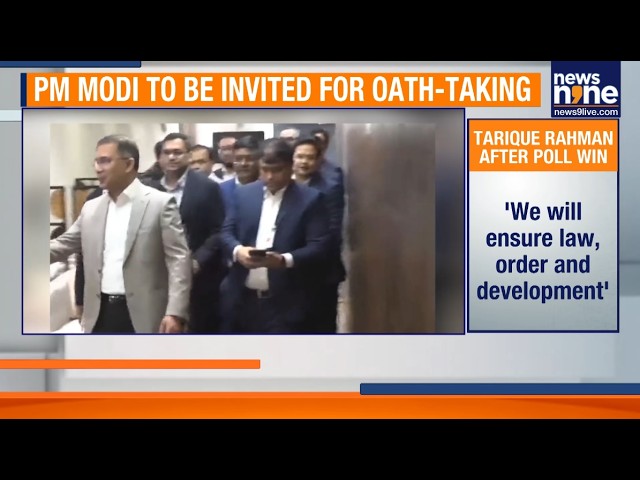
Bangladesh Elections 2026: BNP Victory Paves Way for Tarique Rahman as Prime Minister
Bangladesh

Political
10 min read
Updated By: History Editorial Network (HEN)
Published:
Updated:
Bangladesh Elections 2026 concluded with a sweeping parliamentary victory for the Bangladesh Nationalist Party (BNP), positioning Tarique Rahman to become the country’s next Prime Minister and signaling a shift in Dhaka’s regional and domestic policy direction. The national vote, held across Bangladesh’s 300 parliamentary constituencies, resulted in a clear majority for the BNP in the Jatiya Sangsad, enabling the party to form a government without requiring a coalition.
The Bangladesh Nationalist Party (BNP), led by Tarique Rahman, secured a landslide victory in the 13th National Parliamentary Elections held on February 12, 2026. This election was the first since the 2024 uprising that ended the 15-year rule of Sheikh Hasina's Awami League, which was barred from participating.
• Voter Turnout: ~60% (significant increase from 42% in 2024)
• Total Registered Voters: 127,711,793
• Total Seats: 350 (300 directly elected, 50 reserved for women)
• Seats in Play (Feb 12): 299 (one seat postponed due to a candidate's death)
As of mid-February 2026, the Election Commission has released unofficial results for 297 out of 300 seats.
• BNP-led Alliance: 212 seats (Two-thirds majority)
• BNP (Solo): 209 seats
• Jamaat-e-Islami-led Bloc: 77 seats
• Jamaat (Solo): 68 seats (its best-ever performance)
• National Citizen Party (NCP): 6 seats
• Independents & Others: 14 seats
Held alongside the general election, the "July Charter" referendum proposed major reforms including prime ministerial term limits and a bicameral legislature.
• Approval Rate: ~73% of counted votes favored the charter.
• Total Votes: Approximately 48 million "Yes" votes versus 23 million "No" votes.
Key Highlights:
• Tarique Rahman: The BNP chief won both the seats he contested (Dhaka-17 and Bogura-6) and was poised to become the next Prime Minister.
• Gayeshwar Chandra Roy: A senior BNP leader, became the first-ever Hindu MP from a Dhaka constituency (Dhaka-3).
• Representation: Directly elected women representation hit a two-decade low, with only 7 women candidates winning their constituencies.
• Firsts: This was the first election in Bangladesh history to facilitate postal voting for expatriates.
Bangladesh Nationalist Party (BNP), one of the country’s two dominant political forces, campaigned on themes of governance reform, economic management, and foreign policy recalibration. Central to the campaign was party leader Tarique Rahman, who declared that his administration would pursue a “Bangladesh First” policy. In post-election remarks, party officials stated that the approach would prioritize national sovereignty, economic self-reliance, and balanced diplomacy in relations with neighboring powers.
Tarique Rahman, long a prominent figure within the BNP, is expected to formally assume office following the constitutional process of government formation. Under Bangladesh’s parliamentary system, the president appoints as prime minister the leader who commands a majority in the Jatiya Sangsad. Preparations for the swearing-in ceremony are anticipated to follow certification of final results by the Election Commission.
Foreign policy featured prominently in the campaign and in early statements from the incoming leadership. BNP representatives emphasized recalibrating ties with India and Pakistan in line with national interests. Regarding India, Bangladesh’s largest trading partner and a key regional stakeholder, the new administration signaled its intention to review trade imbalances, water-sharing agreements, border management cooperation, and energy connectivity projects. Officials stated that bilateral relations would continue but would be guided by reciprocity and economic advantage for Bangladesh.
On relations with Pakistan, BNP figures indicated openness to expanding diplomatic and economic engagement, including potential trade normalization and cultural exchanges, while maintaining Bangladesh’s independent foreign policy stance. The party stressed that improved ties with Islamabad would not come at the expense of existing regional commitments. Analysts note that Bangladesh’s geographic and economic position requires careful management of relations with both neighbors, as well as with broader regional blocs in South Asia.
Domestically, the BNP campaign platform included pledges to address inflation, employment generation, foreign currency reserves, and infrastructure development. Party leaders also spoke about strengthening democratic institutions and administrative accountability. Economic indicators, including export earnings from the garment sector and remittance flows from overseas workers, were central to campaign debates.
#BangladeshElections2026
Primary Reference
Bangladesh Election Commission

Explore the Life Moments of
 AI Twin