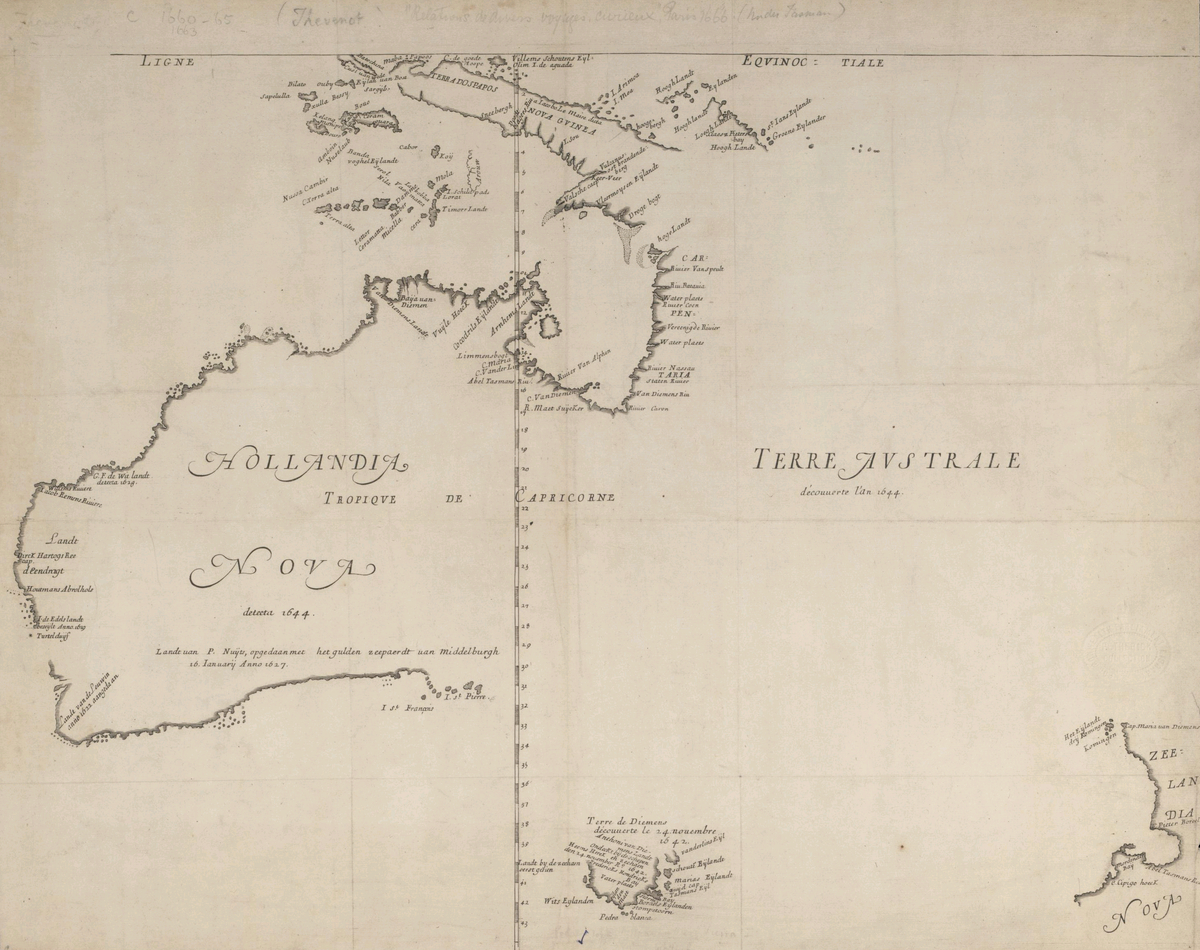
Permission was granted to change the name of the continent from "New Holland" to "Australia".
Australia
8 min read
Updated By: History Editorial Network (HEN)
Published:
In 1824, a pivotal moment in the history of Australia occurred when permission was granted to officially change the name of the continent from "New Holland" to "Australia." This decision marked a major step in the formation of the continent’s modern identity, reflecting a shift towards a unified and distinct national consciousness.
Historical Context
Before the official name change, the continent was commonly referred to as "New Holland," a name given by Dutch explorers in the 17th century. The Dutch, notably Abel Tasman in 1644, had mapped parts of the western and northern coasts and used the name to reflect their homeland, the Netherlands. Despite British exploration and settlement beginning in the late 18th century, the term "New Holland" persisted, particularly for the western regions.
Matthew Flinders' Influence
The push towards the name "Australia" can largely be credited to Matthew Flinders, an esteemed English navigator and cartographer. Flinders was the first to circumnavigate and map the entire coastline of the continent between 1801 and 1803 aboard the HMS Investigator. His detailed maps and extensive studies provided a comprehensive understanding of the land, highlighting its uniqueness.
In his 1814 publication "A Voyage to Terra Australis," Flinders advocated for the name "Australia," arguing that it was more suitable and harmonious. He wrote that "Australia" was more appropriate for the whole landmass and preferred it over "Terra Australis" and other terms. Flinders’ proposal resonated with many, including influential figures such as Governor Lachlan Macquarie.
Governor Lachlan Macquarie's Role
Governor Lachlan Macquarie, who served as the Governor of New South Wales from 1810 to 1821, was instrumental in the campaign to adopt the name "Australia." Macquarie shared Flinders' vision and recognized the importance of a distinct and unifying name for the continent. In 1817, he formally petitioned the British Admiralty to adopt "Australia" officially, highlighting its appropriateness and the growing sentiment among the colonists.
Official Adoption in 1824
The British Admiralty's acceptance of Macquarie's petition culminated in 1824 when they officially endorsed the use of the name "Australia" for the continent. This decision marked the end of "New Holland" as the official designation and solidified "Australia" in official documents, maps, and discourse.
Significance of the Name Change
The adoption of the name "Australia" was more than a mere terminological change; it symbolized the continent’s emerging identity and unity. The new name helped foster a sense of shared destiny among the various colonies and settlers, which was crucial as they navigated the complexities of establishing a new society far from Europe.
Legacy and Impact
The decision to name the continent "Australia" laid the groundwork for its future as a unified nation. It reflected the continent's unique geographical and cultural identity, distinct from European roots. This new identity was pivotal as the colonies moved towards federation, which was realized in 1901 when the Commonwealth of Australia was established.
Matthew Flinders and Governor Lachlan Macquarie are remembered for their significant contributions to this historical milestone. Flinders’ explorations and his advocacy for the name, combined with Macquarie’s administrative support and petitioning, were crucial in this transformative period.
#MomentsOfLife #MoofLife_Moment #MoofLife #Australia #NewHolland #NamingAustralia #MatthewFlinders #LachlanMacquarie #AustralianHistory

Explore the Life Moments of
 AI Twin