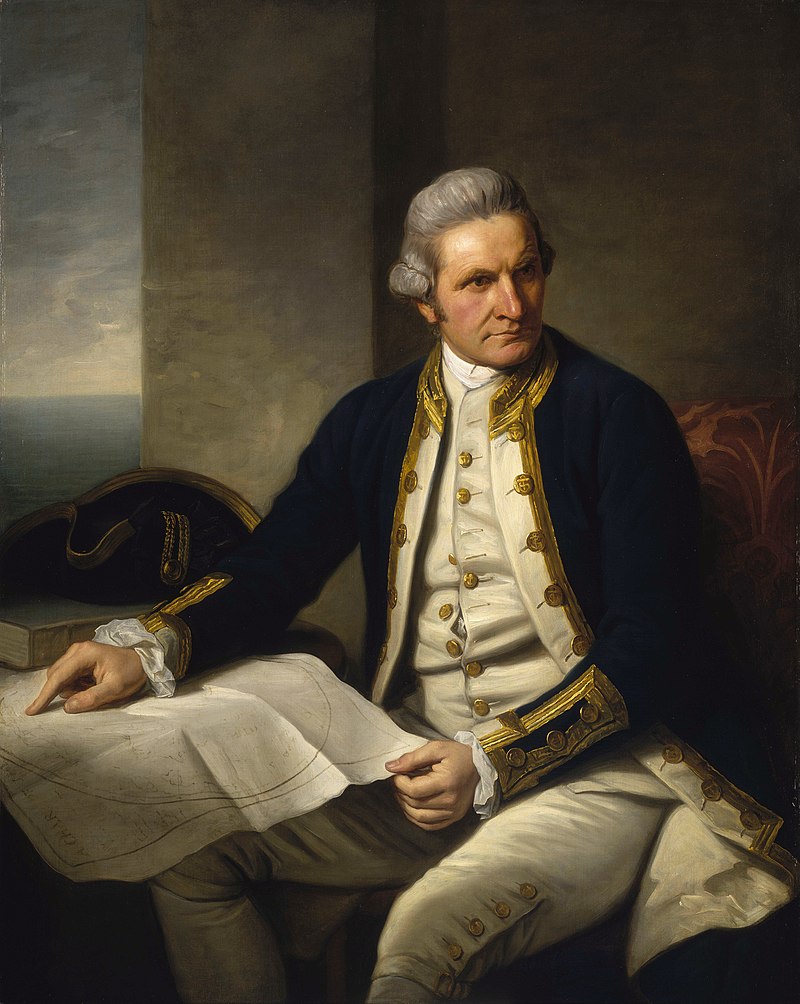
English Lieutenant James Cook's expedition in HMS Endeavour charted the eastern coast, and claimed it for the British Crown. Australia was dubbed "terra nullius".
Australia
10 min read
Updated By: History Editorial Network (HEN)
Published:
Updated:
In 1770, English Lieutenant James Cook led an expedition aboard the HMS Endeavour that significantly altered the course of Australian history. This voyage resulted in the charting of the eastern coast of Australia and its subsequent claim for the British Crown. Cook's journey and his actions marked the beginning of European colonization in Australia, fundamentally transforming the continent's history and its indigenous cultures.
The Voyage of HMS Endeavour
James Cook's voyage was part of a broader British endeavor to explore the unknown territories of the South Pacific. The HMS Endeavour set sail from England in 1768 with a dual mission: to observe the transit of Venus across the sun, which would help in determining the Earth’s distance from the sun, and to seek out the rumored southern continent, Terra Australis Incognita.
After completing the astronomical observations in Tahiti, Cook directed the Endeavour towards the southwest. In April 1770, the expedition reached the southeastern coast of Australia. Cook and his crew made their first landfall at a place they named Botany Bay, located in present-day New South Wales.
Charting the Eastern Coast
Over the next few months, Cook and his crew meticulously charted the eastern coastline of Australia, a task that involved navigating treacherous waters and documenting the diverse landscapes they encountered. Cook's detailed maps and records were invaluable, providing the first comprehensive European documentation of Australia's eastern seaboard.
As they journeyed northward, Cook named many geographical features along the coast, including Cape Tribulation and the Endeavour River, where the ship was temporarily beached for repairs after hitting a reef. The charts created by Cook were remarkably accurate for their time and remained essential for future navigators.
Claiming Australia for the British Crown
On August 22, 1770, Cook performed a formal ceremony at Possession Island in the Torres Strait, claiming the entire eastern coast of Australia for the British Crown. He named the territory New South Wales. This act of claiming sovereignty was based on the concept of "terra nullius," a Latin term meaning "land belonging to no one." The British justified their claim by asserting that the land was uninhabited in a legal sense, as they did not recognize the existing Indigenous populations and their complex societies.
Impact on Indigenous Australians
The notion of "terra nullius" ignored the presence and rights of the Aboriginal and Torres Strait Islander peoples who had inhabited Australia for tens of thousands of years. These communities had their own rich cultures, languages, and social structures, deeply connected to the land. Cook's claim set the stage for the subsequent British colonization, which had devastating effects on Indigenous populations.
The arrival of Europeans brought diseases to which the Indigenous Australians had no immunity, resulting in significant population declines. Furthermore, the colonization process involved the seizure of land, the disruption of traditional lifestyles, and violent conflicts. The impact of these events is still felt today, as Indigenous Australians continue to strive for recognition, rights, and reconciliation.
Legacy of Cook's Expedition
James Cook's 1770 expedition is often seen as a pivotal moment in Australian history. It opened the continent to European exploration and eventual colonization, which transformed Australia's demographic, cultural, and political landscape. Cook himself became a prominent figure in history, celebrated for his contributions to navigation and exploration, yet also scrutinized for his role in the imperial expansion that disregarded Indigenous sovereignty.
The legacy of Cook's voyage is complex and multifaceted. On one hand, it represents a remarkable feat of exploration and scientific achievement. On the other hand, it marks the beginning of a colonial era that brought profound changes and hardships to Indigenous Australians.
Today, the events of 1770 are remembered and reassessed in various ways. There are commemorations of Cook's achievements in navigation and mapping, as well as critical reflections on the consequences of colonization. Efforts towards reconciliation and acknowledging the rights and histories of Indigenous peoples are ongoing, as Australia continues to confront and learn from its past.
#MomentsOfLife #MoofLife_Moment #MoofLife #JamesCook #HMSEndeavour #AustralianHistory #IndigenousHistory #ColonialImpact

Explore the Life Moments of
 AI Twin