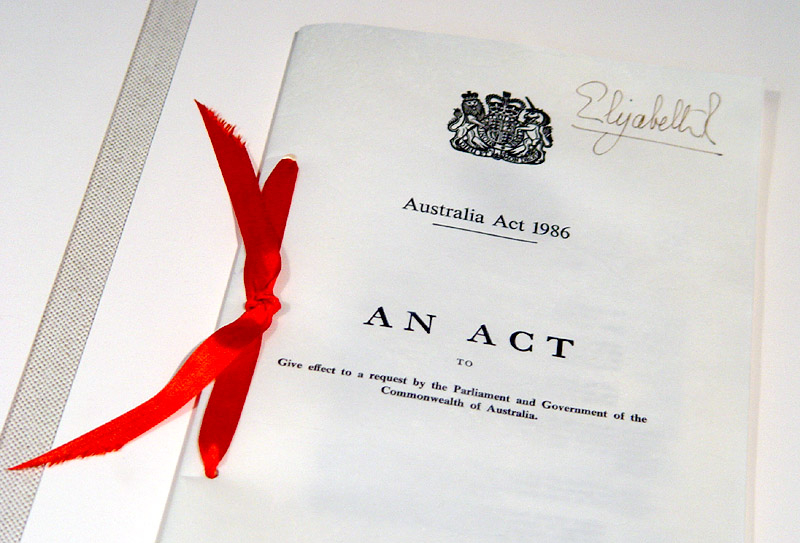
Australia Act abolishes UK's legal authority, solidifying Australian autonomy.
Australia
Political
Global Trade
4 min read
Updated By: History Editorial Network (HEN)
Published:
Updated:
During the event where the Australia Act was implemented, a constitutional milestone was reached as Australia removed the right of appeal from State courts to the British Privy Council. This decision solidified the High Court as the final court of appeal in the country. Additionally, all remaining rights of the UK parliament to pass laws for Australia were eliminated.
The background of this event can be traced back to Australia's gradual steps towards full independence. Over time, Australia had been asserting its autonomy in various aspects, including legal matters. The reliance on the British Privy Council for the final judicial decision had been increasingly seen as outdated, prompting the need for a more independent legal system.
The impact of the Australia Act was significant. By making the High Court the ultimate authority in legal matters, Australia bolstered its sovereignty and autonomy. The removal of the UK parliament's ability to pass laws for Australia meant that the country had full control over its legislative processes. This marked a crucial moment in Australia's history, symbolizing a further step towards complete independence.
In conclusion, the Australia Act's implementation in 1986 marked a defining moment in Australia's journey towards full independence. By removing the right of appeal to the British Privy Council and eliminating the UK parliament's ability to pass laws for Australia, the country solidified its sovereignty and autonomy in legal and legislative matters.
#Australia #Independence #LegalAutonomy #Sovereignty

Explore the Life Moments of
 AI Twin