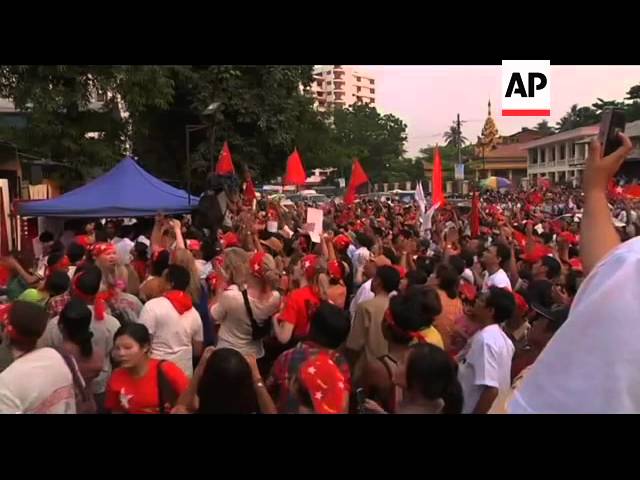
Aung San Suu Kyi wins parliamentary seat
Kawhmu Township, Yangon Region, Myanmar
Politics
Elections
Leadership
9 min read
Updated By: History Editorial Network (HEN)
Published:
Updated:
On 01/04/2012, Myanmar opposition leader Aung San Suu Kyi won a parliamentary seat for the first time in her political career during the country’s by-elections, representing Kawhmu Township, a constituency located south of Yangon. She ran as the candidate of the National League for Democracy (NLD), the party she had led for decades while campaigning for democratic reforms in Myanmar.
Early results from the vote indicated that Suu Kyi secured a decisive victory in the Kawhmu constituency, defeating her main opponent from the Union Solidarity and Development Party (USDP), a party associated with the former military government. Initial reports from election officials and observers indicated that she won with roughly 65% to 90% of the vote, reflecting strong support from voters in the area. The by-election itself filled 45 vacant seats in Myanmar’s national parliament and regional assemblies, seats that had been vacated after several lawmakers joined the government.
The broader results also showed a strong performance by the NLD. The party won 43 of the 44 parliamentary seats it contested, giving it a presence in the legislature after years of political exclusion. Although the by-elections represented only a small portion of the total seats in parliament, the outcome demonstrated public support for the opposition movement led by Suu Kyi. The NLD had previously won the 1990 general election, but the military government at the time did not allow the party to form a government.
Suu Kyi’s election to parliament came after a long period during which she had been prevented from participating in formal politics. She had spent approximately 15 years under house arrest between 1989 and 2010 due to her role in Myanmar’s pro-democracy movement. Internationally, she had been awarded the Nobel Peace Prize in 1991 while still under detention. Her successful candidacy in the 2012 by-election therefore marked her transition from opposition activist to elected legislator.
The by-election was closely watched by international governments and organizations as a test of political reforms introduced by Myanmar’s administration after the end of direct military rule in 2011. Following the vote and the participation of the NLD in the political process, several Western governments began reassessing their policies toward the country. In April 2012, the European Union announced the suspension of many economic sanctions against Myanmar while maintaining an arms embargo.
After the election victory, Suu Kyi formally took her parliamentary seat in the national legislature on 02/05/2012, when she and other newly elected NLD lawmakers were sworn in at the parliament complex in Nay Pyi Taw, Myanmar’s administrative capital.
● Aung San Suu Kyi's election to the Pyithu Hluttaw marked a pivotal moment in Myanmar's political landscape. Her party, the National League for Democracy (NLD), achieved a remarkable victory by securing 43 out of 45 available seats in the by-elections. This success was not only a personal triumph for Suu Kyi but also a significant endorsement of her party's platform and vision for the country. The announcement of her victory was made by the Union Election Commission and broadcasted on state-run media, confirming her role as a key political figure in Myanmar. As a result of this election, Aung San Suu Kyi became the Leader of the Opposition in the Pyidaungsu Hluttaw, the national assembly of Myanmar, which positioned her as a central player in the ongoing political dialogue and reform process in the country.
The impact of Aung San Suu Kyi's election extended beyond her immediate political role. It symbolized a shift towards greater democratic engagement in Myanmar, following years of military rule and political repression. The NLD's success in the by-elections was seen as a reflection of the public's desire for change and a move towards a more open and democratic society. This election was a crucial step in the broader context of Myanmar's political transition, as it demonstrated the potential for opposition parties to gain power and influence within the government. The participation of the NLD in the parliamentary process also provided a platform for addressing key issues such as human rights, economic development, and national reconciliation, which were critical for the country's future stability and growth.
#mooflife
#MomentOfLife
#AungSanSuuKyi
#MyanmarPolitics
#Nld
#PyithuHluttaw
#DemocraticTransition
Primary Reference
Burma's Aung San Suu Kyi wins by-election: NLD party

Explore the Life Moments of
 AI Twin