Aung San Suu Kyi's Rise to Prominence
Myanmar
Politics
Leadership
4 min read
Updated By: History Editorial Network (HEN)
Published:
Updated:
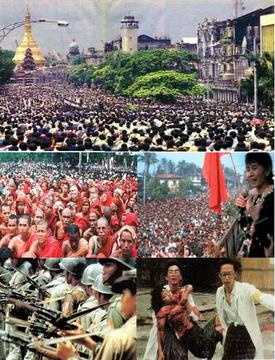
In August 1988, Aung San Suu Kyi rose to national prominence during a period of mass protests in Myanmar, commonly known as the 8888 Uprising. The demonstrations began on 08/08/1988, a date chosen in part for its numerical significance, and were driven by widespread dissatisfaction with decades of military rule. The unrest followed the resignation of long-time leader Ne Win, whose policies had contributed to economic decline and political repression.
The protests brought together large numbers of students, workers, monks, and civil servants calling for democratic reforms. In response, the military intervened with force, leading to a violent crackdown that resulted in significant casualties and arrests. During this period, Suu Kyi, who had recently returned to Myanmar earlier in 1988 to care for her mother, became actively involved in the movement. On 26/08/1988, she delivered a public address at the Shwedagon Pagoda in Yangon, where she called for democratic governance and non-violent political change.
Following the uprising, Suu Kyi co-founded the National League for Democracy (NLD) and emerged as one of its leading figures. Her approach emphasized non-violent resistance and political dialogue. In 1990, the NLD participated in general elections and won a majority of the contested seats. However, the military authorities did not recognize the results and retained control of the government. By that time, Suu Kyi had been placed under house arrest in 1989, limiting her direct participation in political activities.
The events of 1988 and their aftermath marked the beginning of Suu Kyi’s sustained involvement in Myanmar’s political movement. The uprising and subsequent developments drew international attention to the country’s internal situation and to the activities of opposition groups advocating for democratic reforms.
#mooflife
#MomentOfLife
#AungSanSuuKyi
#Burma
#Democracy
#8888Uprising
#NationalLeagueForDemocracy
Primary Reference
8888 Uprising

Explore the Life Moments of
 AI Twin