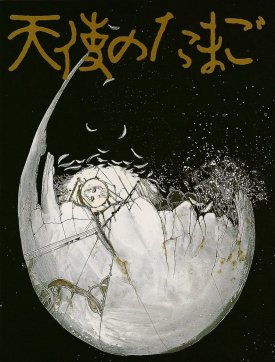
Angel's Egg
Entertainment
7 min read
Updated By: History Editorial Network (HEN)
Published:
Updated:
Angel’s Egg (Tenshi no Tamago, 1985) is a cryptic, atmospheric Japanese animated art film directed by Mamoru Oshii and featuring surrealist designs by Yoshitaka Amano. It is widely regarded as one of the most enigmatic and interpretive works in animation history. Set in a dark, abandoned, almost post-apocalyptic world, the story follows a young girl who protects a large, mysterious egg as she wanders a desolate cityscape. She eventually encounters a nameless soldier-like man, and their brief, ambiguous conversations form the core of the film’s narrative—or more accurately, its philosophical inquiry.
Narratively sparse and almost entirely devoid of dialogue, Angel’s Egg is more concerned with atmosphere, symbolism, and visual metaphor than conventional plot. It delves into themes of faith, lost innocence, rebirth, memory, and despair—drawing on Christian iconography, existential dread, and dream logic. The film resists direct interpretation, instead inviting viewers to project their own meaning onto its quiet, decaying world. Many believe it reflects Oshii’s personal crisis of faith, following his departure from religion in the early 1980s.
Visually, the film is breathtaking. Amano’s gothic, baroque artwork is brought to life through detailed, hand-drawn backgrounds, moody lighting, and long, slow shots that linger on empty spaces, decaying machinery, and ruined architecture. The haunting ambient soundtrack by Yoshihiro Kanno reinforces the film’s meditative, dreamlike tone. It feels more like a moving painting than a traditional film—a tone poem in visual form.
At the time of its release, Angel’s Egg had limited commercial reach. It was financed by Tokuma Shoten and released as a direct-to-video feature under their “OVA” (original video animation) label. With virtually no marketing and its heavily experimental nature, the film remained largely unknown outside Japan until it was discovered by international anime enthusiasts and art film collectors in the 1990s and 2000s through bootlegs and subtitled fan copies.
Critically, the film received mixed initial reactions—praise for its visuals, but confusion or frustration over its abstract storytelling. However, in the years since, it has become a cult classic, particularly among fans of avant-garde cinema and experimental animation. It is often cited alongside films like 2001: A Space Odyssey, Eraserhead, and The Holy Mountain as a benchmark in symbolic, non-linear filmmaking.
While Angel’s Egg didn’t win major awards upon release, it’s now considered a seminal work of anime art cinema. It has been analyzed in academic circles for its use of religious symbolism and postmodern narrative structure. Mamoru Oshii would later go on to direct the influential Ghost in the Shell (1995), but Angel’s Egg remains his most personal and haunting work.
The legacy of Angel’s Egg lies in its commitment to pure, unfiltered expression. It rejects commercialism and narrative clarity in favor of emotion, symbolism, and philosophical depth. It continues to challenge and inspire animators, filmmakers, and artists around the world who see animation as more than entertainment—but as poetry, dream, and existential art.
Primary Reference
Angel's Egg 4K Remaster Heads to North American Theaters

Explore the Life Moments of
 AI Twin