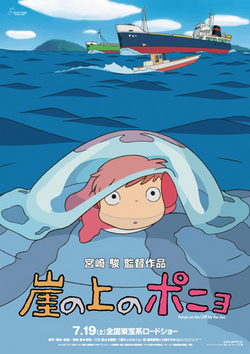
Ponyo
Entertainment
6 min read
Updated By: History Editorial Network (HEN)
Published:
Updated:
Ponyo (2008) is a Japanese animated fantasy film written and directed by Hayao Miyazaki and produced by Studio Ghibli. Loosely inspired by Hans Christian Andersen’s The Little Mermaid, the story follows Ponyo, a magical goldfish who longs to become human after befriending a five-year-old boy named Sosuke. When she escapes from the sea and begins transforming into a little girl, her presence begins to disrupt the balance of nature, unleashing storms and high tides that threaten the human world. As Ponyo and Sosuke form a deep bond, they must prove the purity of their love and intent to restore harmony between land and sea.
Visually, Ponyo is a return to hand-drawn, watercolor-like animation at its most vibrant and whimsical. Every wave and splash in the film is drawn by hand, with fluid, expressive motion that captures the chaos and beauty of the sea. The character designs are intentionally simple and childlike, reflecting the film’s perspective through the eyes of young children. The color palette is warm and bright, enhancing the film’s sense of wonder. Joe Hisaishi’s musical score—soaring, classical, and whimsical—perfectly complements the film’s tone, especially in key emotional and underwater scenes.
Financially, Ponyo was a massive hit in Japan. It grossed over ¥15.5 billion (~$204 million USD), making it the highest-grossing domestic film in Japan in 2008. Worldwide, it earned over $205 million, with solid performances in Europe and a carefully managed U.S. release via Disney. Despite being aimed more at younger audiences, its universal themes and rich visuals attracted viewers across all age groups.
Critics praised Ponyo for its artistry, heart, and environmental subtext. It holds a 91% rating on Rotten Tomatoes and a Metacritic score of 86, with reviewers highlighting the film’s visual inventiveness, gentle storytelling, and emotional sincerity. Some noted that the narrative lacks the structure or tension of Miyazaki’s more complex films, but many appreciated its purity and commitment to a child’s view of the world—free from cynicism or irony.
The film won several major awards, including the Japan Academy Prize for Animation of the Year and Best Animated Feature at the Los Angeles Film Critics Association Awards. It was also nominated for numerous international honors, including the Golden Lion at the Venice Film Festival.
The legacy of Ponyo lies in its role as Miyazaki’s most child-friendly and visually experimental work. It marked a creative shift toward embracing innocence and the natural world with even greater intensity. While it may not be as narratively complex as Spirited Away or Princess Mononoke, Ponyo remains a testament to the emotional power of animation and Miyazaki’s unique ability to craft magical worlds through hand-drawn beauty and deep empathy.
Primary Reference
Ponyo on the Cliff by the Sea

Explore the Life Moments of
 AI Twin