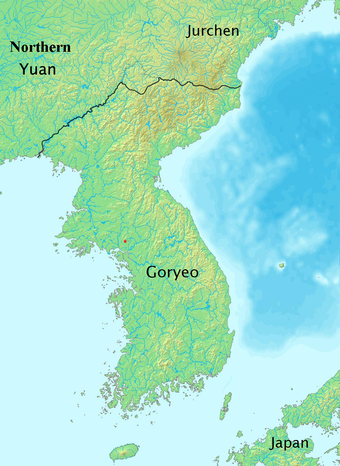
Goryeo's Conquest and Defense in Turbulent Times
Goryeo Kingdom (northern Korean Peninsula and Liaodong region)
Goryeo
Military
5 min read
Updated By: History Editorial Network (HEN)
Published:
Updated:
In 1356, the Goryeo Kingdom initiated a series of military and political actions under King Gongmin to reclaim sovereignty after decades of Mongol (Yuan) dominance. Since the mid-13th century, Goryeo had been under strong Yuan influence, with Mongol-controlled administrative regions established in northern territories and pro-Yuan factions holding power within the royal court. By the mid-14th century, as the Yuan Dynasty weakened, King Gongmin moved to restore internal authority and territorial control.
A central event of this effort was the recapture of Ssangseong Prefecture (Ssangseong Chonggwanbu), a strategic northeastern administrative center that had been under direct Mongol control since 1258. King Gongmin appointed General Yu In-woo to lead the campaign, which resulted in the destruction of the Mongol administrative office and the restoration of Goryeo control over the region. The success of this operation extended Goryeo’s northern frontier and strengthened its military position in the area.
A key factor in the campaign was the defection of Yi Jachun and his son Yi Seong-gye, who had previously served as local officials under Mongol authority. Their decision to support Goryeo provided both military assistance and local knowledge that contributed to the success of the अभियान. Yi Seong-gye would later become a central figure in Korean history as the founder of the Joseon Dynasty in 1392. Alongside Ssangseong, additional territories such as Haryang-bu and Ganggye were brought back under Goryeo control, helping define parts of Korea’s later northern boundaries.
At the same time, King Gongmin carried out internal reforms aimed at eliminating pro-Yuan influence within the court. In 1356, he ordered the purge of the Ki family, led by Ki Cheol, whose political power was closely tied to the Yuan court through Empress Gi. This action removed a major source of foreign influence in Goryeo governance and reinforced the king’s authority.
The developments of 1356 occurred during a broader period of instability in East Asia. As the Yuan Dynasty declined, Goryeo also faced external threats, including invasions by Red Turban rebels in 1359 and 1360. In the same year as the Ssangseong campaign, Goryeo forces under commanders such as Ji Yongsu and Yi Seong-gye conducted operations in the Liaoyang region to further weaken remaining Mongol control near its borders.
#mooflife
#MomentOfLife
#Goryeo
#Liaoyang
#RedTurbans
#YuanDynasty
#MilitaryHistory
Primary Reference
Goryeo

Explore the Life Moments of
 AI Twin