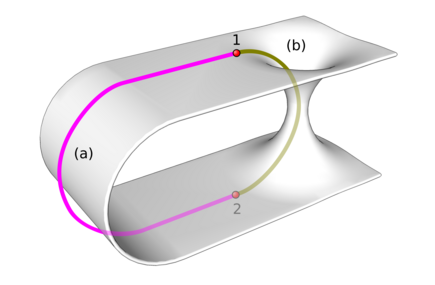
Einstein-Rosen Bridge: Theoretical Model for Spacetime Connectivity and Exploration
German
Science
4 min read
Updated By: History Editorial Network (HEN)
Published:
Updated:
Albert Einstein collaborated with Nathan Rosen to develop the theoretical model known as the Einstein-Rosen bridge, often referred to as a wormhole. This work took place in the context of seeking solutions to the equations of general relativity, a framework Einstein himself had formulated earlier.
The goal was to explore possible connections between different regions of spacetime. This collaboration resulted in the concept of a 'bridge' or tunnel within the fabric of spacetime, theoretically allowing for a shortcut between two distant points. The model was published in a notable scientific paper, helping to push the boundaries of theoretical physics regarding the nature of space and time.
The Einstein-Rosen bridge, although purely theoretical and not yet observed in reality, has since been a vital part of scientific discussions on general relativity and quantum mechanics. It sparked interest in the possibility that such structures might exist in the universe and could potentially facilitate faster-than-light travel, although this remains speculative. The concept has also had profound implications for the study of black holes and the internal structure of the universe.
The collaboration between Einstein and Rosen was significant in opening new avenues for the exploration of the universe's underlying mechanics, impacting subsequent theoretical research. Their work laid foundational ideas that have been expanded upon and scrutinized in contemporary physics.
#MoofLife #EinsteinRosenBridge #Wormholes #GeneralRelativity #TheoreticalPhysics
Explore the Life Moments of
 AI Twin