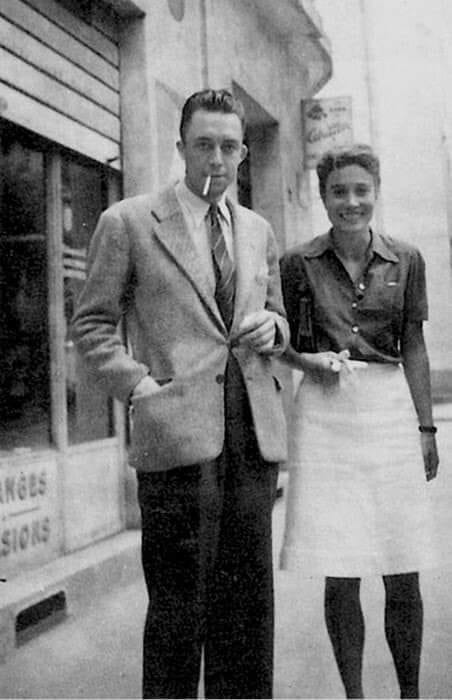
Albert Camus marries Francine Faure: A union shaping existential thought amidst political turmoil.
Lyon, France

Family
6 min read
Updated By: History Editorial Network (HEN)
Published:
Updated:
Albert Camus married Francine Faure in Lyon. Francine Faure was a multi-faceted individual known for her skills as a pianist and a mathematician. Camus, a prominent existentialist philosopher, author, and journalist, found a partner who complemented his intellectual pursuits. The wedding took place during a period marked by political upheaval in Europe, profoundly shaping the lives of both Camus and Faure.
Camus, born in Algeria, was gaining recognition in literary circles, laying the groundwork for works like "The Stranger" and "The Myth of Sisyphus." Francine Faure's background in mathematics and music added a unique dimension to their relationship. Their union symbolized a merging of different worlds—literature, philosophy, mathematics, and the arts. This marriage occurred shortly before Camus published some of his most influential works, which have since contributed significantly to existentialist thought.
As his second wife, she provided stability to his life, though the marriage was strained by his infidelities. They had twins, Catherine and Jean, in 1945.
Key Details Regarding the Marriage:
• Background: They met in 1937 in Algiers.
• Life in Algiers: The couple moved to Oran, Algeria, where they taught.
• Challenges: Despite his general indifference toward formal marriage, they remained married until his death in 1960.
• Impact of Affairs: Francine suffered from depression due to Camus's intense, long-term affair with actress Maria Casarès.
The impact of their marriage extended beyond their personal lives. Faure's intelligence and artistic sensibilities likely influenced Camus's work, adding depth to his existential musings. While Camus's literary works often focused on themes of absurdity, freedom, and rebellion, Faure's presence may have offered him a nuanced perspective on these ideas.
Historians and scholars note that around 1942, France was under German occupation. This context added a layer of complexity to their marriage, as intellectual and artistic freedoms were increasingly suppressed. Camus continued to write and engage in the intellectual resistance against totalitarianism, an endeavor that may have been bolstered by Faure's unwavering support.
Their relationship faced difficulties, partly due to Camus's infidelities and the couple's separation during periods of the war. Despite these challenges, their marriage remained a significant aspect of Camus's personal life and intellectual journey. This event stands as a testament to the intertwined nature of personal relationships and creative endeavors.
#AlbertCamus #FrancineFaure #Existentialism #Lyon #IntellectualMarriage
#Francine-Faure
Primary Reference
Francine Faure - Wikipedia
Explore the Life Moments of
 AI Twin