The 1630 Initiation of Coffee Trade by the East India Company from Mocha
Mocha, Yemen
Trade
Economy
7 min read
Updated By: History Editorial Network (HEN)
Published:
Updated:
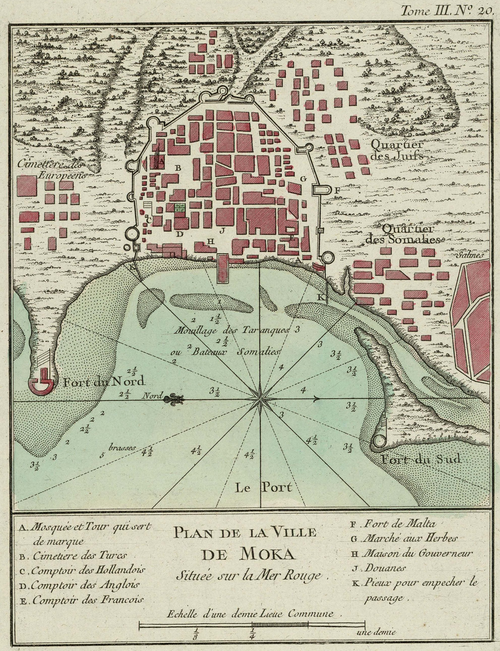
Around 1630, the Yemeni port city of Mocha became a central hub in the expanding international coffee trade as European trading companies, including the British East India Company and the Dutch East India Company, increased direct maritime commerce with southern Arabia. The growing involvement of European merchants helped transform coffee from a regional beverage into a globally traded commodity.
Coffee had already been widely consumed for generations across Yemen, the Arabian Peninsula, and parts of the Ottoman Empire before European traders became deeply involved in the trade. By the early seventeenth century, Yemen held a dominant position in global coffee production and export. Coffee cultivated in Yemen’s highland regions was transported through Red Sea ports, especially Mocha, which became internationally associated with the coffee trade and later gave its name to the term “mocha” in global commerce.
Ottoman authorities and Yemeni merchants tightly controlled coffee exports during this period. To preserve their monopoly on cultivation, exported coffee beans were often roasted or boiled before shipment to prevent foreign growers from successfully planting fertile seeds elsewhere. This policy helped maintain Yemen’s exclusive position in coffee production for much of the seventeenth century.
By around 1630, the British East India Company had begun exploring coffee as a profitable commodity within its broader Indian Ocean trade networks. Early British commercial activity focused less on direct export to England, where coffee consumption remained limited, and more on supplying markets in Persia and Mughal India. Coffee shipments from Mocha moved through interconnected maritime routes linking the Red Sea, the Arabian Sea, India, and East Africa.
The Dutch East India Company also expanded its presence in the region during the same era. Dutch merchants and travelers visiting Mocha became among the first Europeans to closely observe coffee cultivation and consumption practices in Yemen. Historical accounts associated with traders such as Pieter van den Broecke documented coffee drinking in Mocha and helped introduce knowledge of the beverage to wider European audiences.
Competition among European trading powers eventually contributed to the spread of coffee cultivation beyond Yemen. Dutch efforts later succeeded in obtaining live coffee plants, allowing cultivation in Southeast Asia, particularly on the island of Java. This development gradually weakened Yemen’s monopoly over global coffee production during the following centuries.
Despite later competition, Mocha remained one of the world’s most important coffee trading ports throughout much of the seventeenth and eighteenth centuries. The city’s prosperity became closely tied to the international demand for Yemeni coffee and the expansion of maritime trade across the Indian Ocean and Red Sea.
Historical Significance
The expansion of coffee trade through Mocha around 1630 helped connect Yemen to emerging global commercial networks linking Europe, the Middle East, Africa, and Asia. Yemen’s early dominance in coffee production also played a major role in shaping the worldwide spread of coffee culture and international commodity trade.
Primary Reference
History of coffee

Explore the Life Moments of
 AI Twin