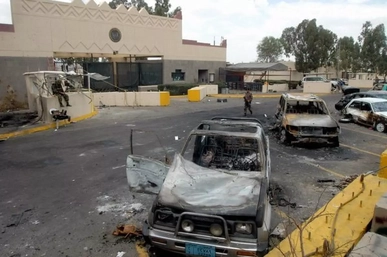
Car Bombings Outside U.S. Embassy
U.S. Embassy, Sana’a, Yemen
Terrorism
Political Violence
International Relations
7 min read
Updated By: History Editorial Network (HEN)
Published:
Updated:
On 17/09/2008, militants carried out a coordinated terrorist attack against the United States Embassy in Sana’a, Yemen, killing at least 16 people in one of the most serious assaults on an American diplomatic mission in the country. The attack involved car bombs, armed gunmen disguised as Yemeni security personnel, and a prolonged exchange of gunfire outside the heavily fortified embassy compound in the Yemeni capital.
According to Yemeni and U.S. officials, approximately seven attackers participated in the operation. The assault began at around 9:15 a.m. local time when one vehicle packed with explosives detonated near the embassy’s outer security gate. A second vehicle and armed militants then attempted to penetrate the compound while gunmen opened fire on security forces. Witnesses reported multiple explosions followed by a gun battle lasting roughly ten minutes as Yemeni security personnel responded to the attack.
The assault killed six Yemeni security guards, four civilians, and all six attackers involved in the operation. Among the civilians killed were a Yemeni woman preparing for her wedding and an 18 year old American woman who had been waiting outside the embassy compound. Despite the scale of the attack, no American embassy personnel were killed or injured because the attackers failed to breach the main embassy perimeter.
A group calling itself Islamic Jihad in Yemen initially claimed responsibility for the assault, although Yemeni and U.S. authorities quickly stated that the operation bore the “hallmarks” of Al Qaeda. Investigators later linked the attack to Al Qaeda in the Arabian Peninsula (AQAP), which was emerging as a growing militant threat in Yemen and the wider region. Officials noted the sophistication of the operation, including the use of fake security uniforms, coordinated vehicle bombs, and simultaneous armed assaults.
The attack occurred during a period of increasing militant activity in Yemen. Earlier in March 2008, mortar rounds fired toward the U.S. Embassy landed near a nearby girls’ school, causing casualties and heightening security concerns around diplomatic facilities. The September assault demonstrated a significant escalation in tactics and operational planning by extremist groups operating in Yemen.
At the time, Yemen faced multiple internal security challenges, including tribal unrest, separatist tensions in the south, and conflicts with Houthi rebels in the north. Weak central authority and difficult terrain allowed militant organizations linked to Al Qaeda to establish networks and training areas in parts of the country. The embassy attack intensified international concern about Yemen becoming a base for transnational extremist operations.
Following the attack, Yemeni authorities increased security operations against suspected militant cells, while the United States expanded counterterrorism cooperation with Yemen. The incident also led to tighter security measures at diplomatic compounds and increased scrutiny of AQAP’s growing capabilities in the Arabian Peninsula.
Historical Significance
The September 2008 embassy attack highlighted the increasing operational sophistication of militant networks in Yemen before the formal emergence of AQAP in 2009. The assault also reinforced concerns within the United States and regional governments that Yemen’s instability could provide opportunities for extremist organizations to expand their influence.
#mooflife
#MomentOfLife
#CarBombings
#UsEmbassy
#Sana'a
#YemenViolence
#DiplomaticSecurity
Primary Reference
10 Are Killed in Bombings at Embassy in Yemen

Explore the Life Moments of
 AI Twin